

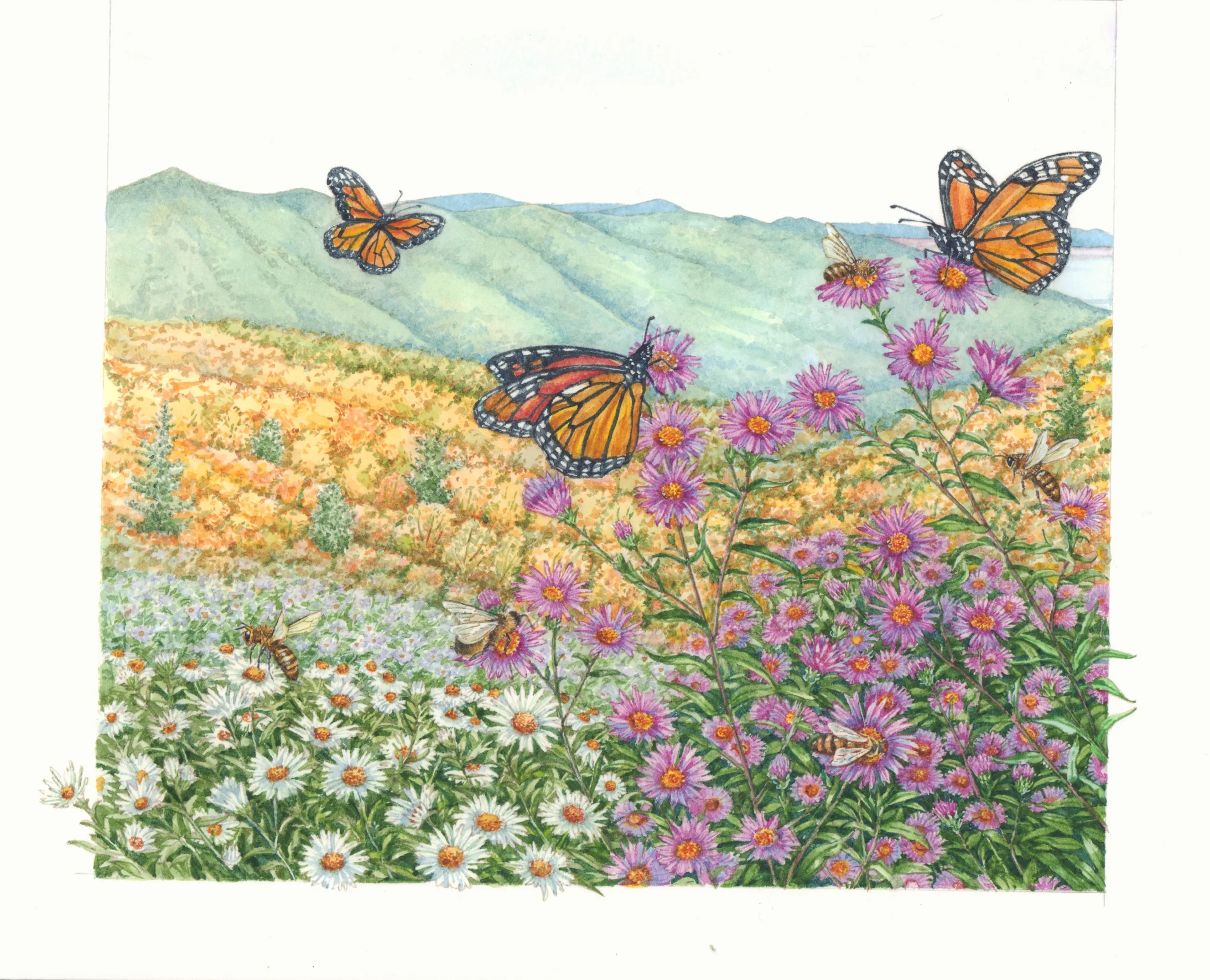
What bees are these? I do not know.
They feast upon my asters though.
When autumn days are looming near,
Bright blooms hold fast to summer’s glow.
True, that’s not what Robert Frost actually wrote. But he could have. Because native North American asters certainly are worthy of a poetic tribute. A final blooming bounty for the eyes—and for the pollinators—asters burst forth just when our gardens seem to have exhausted the last of their summer exuberance, rewarding us with an abundance of brightly colored flowers that linger for weeks.
“Aster” is the common name for these native perennials, which belong to the botanical family asteraceae, aka “the daisy family,” a sprawling garden of plants that includes everything from lettuce and artichokes to dandelions, zinnias, and marigolds. Not that long ago, though, North American asters were found to be genetically distinct from the Eurasian asters with which they share a common name, and thence botanically “reclassified”—apparently fomenting much consternation among planty people.
“This was a hard shift for many,” observed Ryan Pankau, a horticulture educator for the University of Illinois Urbana-Champaign, in a 2021 issue of the College of Agricultural, Consumer, & Environmental Sciences’ The Garden Scoop newsletter. “It seems like the changes among asters have been one of the slowest accepted and most talked about that I have experienced in my botanical career,” he added, conjuring images of gardeners flinging down their pruning shears in high dudgeon and firing off strongly worded letters of reproach to the International Botanical Conference.
Still, you could see where they had a valid bone of contention. “The majority of North American asters were moved to the genus Symphyotrichum,” Pankau pointed out, “which certainly doesn’t roll off the tongue like Aster.”
But here we are, nonetheless, with asters that aren’t really asters, but everyone calls them that anyway.
And these are a few reasons you might consider growing some not-asters yourself.
One, they are native North American plants. That means that they know how to grow here. These are not your fussy, high-strung imports wilting in the Virginia heat and calling weakly for Miracle-Gro. Case in point: Your author has managed to grow asters from seed, and when it comes to gardening skills, I make “benign neglect” look like an aspiration.
“One of the advantages of native plants is that they have really deep roots, and since they have evolved here, they are perfect for the ‘sometimes’ gardener, the ‘hit-or-miss’ gardener, because they really do know how to take care of themselves,” explains Goochland-Powhatan Master Gardener Pat Lust.
Another reason to grow native asters? They’re colorful and bountiful, with masses of flowers in shades from daisy-like creams through deep purples. “Once you bring native plants into your garden, they are spectacularly beautiful,” says Lust. “I don’t think we make enough of the fact that native plants are really beautiful.”
A third count in their favor? Those bountiful blooms provide important sustenance for native pollinators, anchors to our ecosystems that can be easy to take for granted. When you grow natives in your garden, “There will be a whole lot more insect life and butterflies, especially,” notes Lust. Seeing your asters buzzing with bees and aflutter with butterflies is like hosting your own little insect garden party.
Finally, these plants are perennials, which means, of course, that they will keep on keepin’ on, year after year, old friends reliably returning for a fall reunion.
A good source for aster seeds as well as bare root and potted plants is Prairie Moon Nursery (PrairieMoon.com), which offers multiple varieties of asters (along with many other natives) as well as helpful advice. Two oft-mentioned favorites you might consider starting with are New England aster (which, despite its name, has a range that covers much of the United States, including Virginia) and aromatic aster (which is a true late-bloomer that can sometimes continue flowering into November). Frost aster has daisy-like whitish blooms and spreads readily (you call it “aggressive,” I call it less work for me—frost aster has volunteered in several places in my yard, and I say have at it). Or consider the smooth blue aster, which Lust calls a favorite.
And whichever aster-that-isn’t-an-aster you choose, it will be sure to make your fall a little brighter.
Illustration by Liz Pepperell. This article originally appeared in the December 2025 issue.