

A fire raged in Piney. Thick brush and timber fed the flames, fanning across Wythe County woodlands. Deputy County Administrator Matthew Hankins—a certified first responder—joined the Ivanhoe Fire Department crew and volunteers, beating back the blaze as evening fell. As the inferno dwindled, the crew’s voices quieted with it.
Then, from the blackened forest, came a sound that cut through the silence: a thin, persistent cry. Hankins followed the wails. Beneath a downed tree near the fire’s origin, a small black snout poked through the wreckage. A bear cub, alone. Recognizing the noise and flashing lights likely drove its mother away, Hankins scooped up the 5.5-pound bundle in gloved hands and carried him out of the singed remains of home.
“I walked through a crowd of people who were pretty amazed that we’d been able to pull a bear out of there—the fire had burned pretty hot,” Hankins recalls.
With help from onlookers, he tucked the cub into his firefighting jump bag and drove to a Circle K off Interstate 81 to hand him off to a wildlife biologist. She kept the cub overnight before delivering him to the Wildlife Center of Virginia in Waynesboro the next morning.
Meet the Miracle Workers
The cub was headed for one of only three full-service wildlife hospitals in Virginia, where specialists treat thousands of native wild animals each year. By state law, only permitted specialists can care for orphaned or injured wildlife—and these are no ordinary pet vets. Their patients arrive with no owners, little research to guide treatment, few advocates, and often slim chances of survival. About 140 people in Virginia hold rehabilitation permits, some limited to certain species like raptors or squirrels, with many working independently from their homes or through small nonprofits.
But the three donor-supported hospitals host full teams of wildlife professionals, plus trainees: the Blue Ridge Wildlife Center (BRWC) in Boyce, the largest in the mid-Atlantic; the Southwest Virginia Wildlife Center of Roanoke (SWVWCR), which has handled rarities like Eastern spotted skunks; and the Wildlife Center of Virginia (WCV), the only facility licensed to care for black bears statewide.
When the wildfire rescue cub arrived in March 2024, Jenn Dunsheath—a new member of the bear care team—was among the rehabilitators on hand. As the tiny cub rumbled toward Waynesboro, she and her colleagues awaited anxiously. It was not only the first cub of the year but also Dunsheath’s very first to care for.
“It was definitely exciting, but also really nerve-wracking,” she says. “The situation he came from was more traumatic than others—like those where the mom dies—he came from an actual fire. We had to monitor his lungs. Caring for him was a learning curve. You’re nervous. You don’t want to do anything to hurt them, and you’re learning from those before you.”
When the cub arrived, the team determined he was a mere six weeks old, and Dunsheath and her colleagues began the relentless, year-long process of raising him—treating his smoke-damaged lungs, feeding him, and teaching him how to be a bear again, all while never forgetting that he was not theirs to keep.
At Arm’s Length
A key difference between a wildlife rehabilitator and your neighborhood dog-and-cat veterinarian is the relationship to the patient. For one, “our patients don’t want to be here,” says Annie Bradfield, executive director of BRWC. “The top priority is keeping stress levels down their whole time here. We want to stay as far away as possible. A lot of people think, ‘Oh, wildlife hospital, you get to play with animals.’ But it’s not like that at all.”
To preserve that distance, animals aren’t given names but case numbers, usually by year. “Dealing with wildlife, there are lots of ups and downs,” says Chester Leonard, executive director of SWVWCR. “Sometimes they don’t make it. It’s really easy to get attached, and if you name them, it can be especially heartbreaking.”
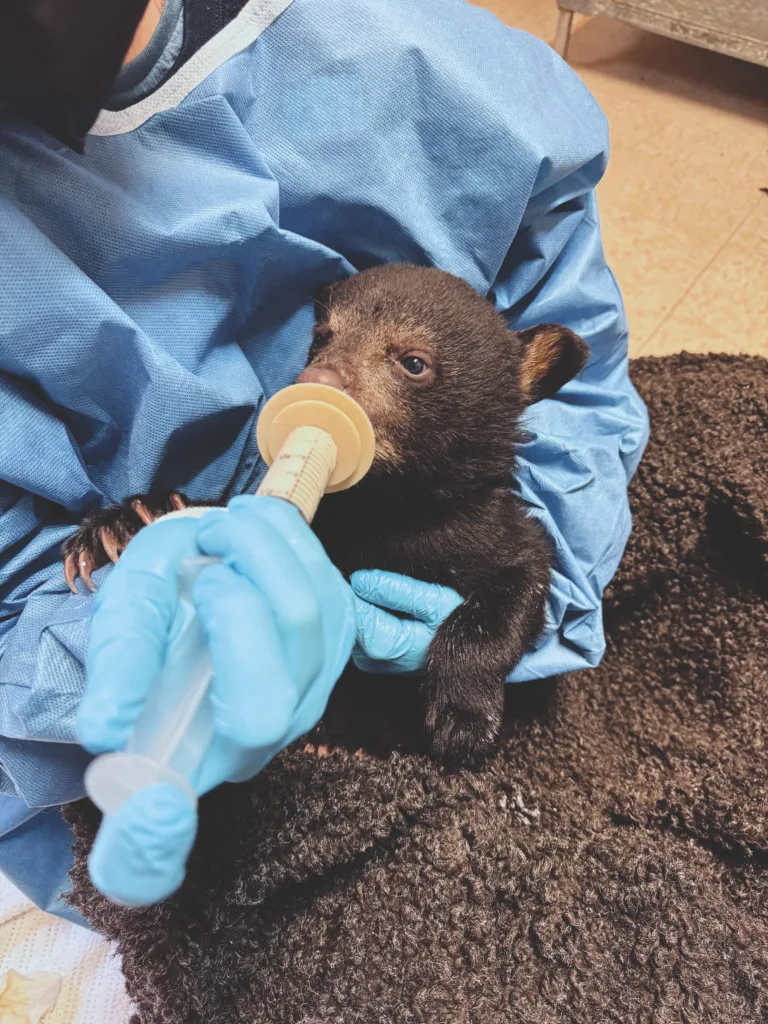
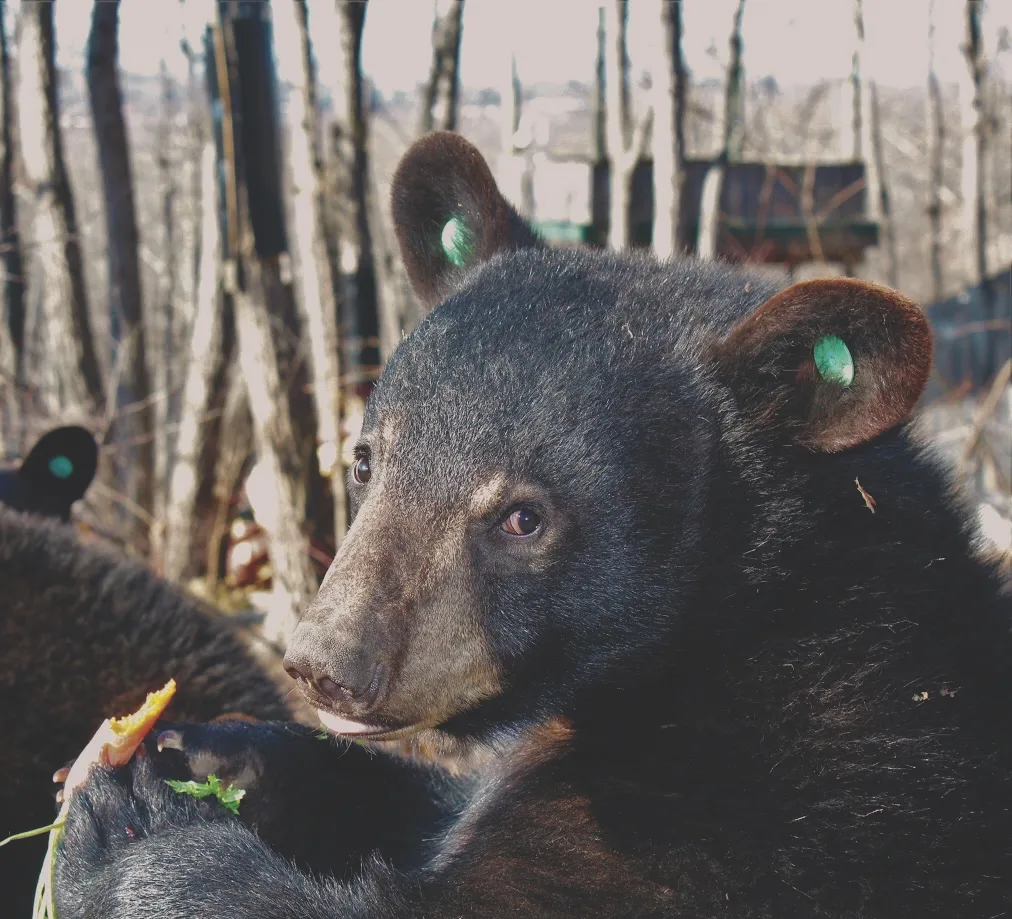
The bear cub from the Piney fire became #24-0302 until his ears were tagged with two green markers—earning him the shorthand “Double Green.” Human voices around him stayed minimal: no baby talk, no comforting hushes, no casual chatter. For an animal destined for release, familiarity with people can be a liability.
But even with safeguards, the instinct to coddle a small, fuzzy (or feathery, or scaly) creature is hard to suppress. For Dunsheath, it was a challenge remembering that Double Green was a bear first. During bottle feedings, she wrapped herself in a brown, fuzzy blanket to mimic a mother bear’s hide, then turned anxiously to her colleague as the cub slurped.
“Is he choking?” she’d nervously ask Alejandra Olvera, a fellow rehabilitator.
“No,” Olvera replied with a chuckle. “He’s tiny, but he’s a bear. This will be fine, trust me.”
When another orphaned cub later joined the center—eventually tagged “Double Orange”—Dunsheath’s worries shifted. The newcomer was smaller, and she fretted over him being bullied at mealtime.
“There was a time I just picked up the smaller cub and fed him in my hands because I was so scared,” she remembers. “[Double Green] was getting way too aggressive—scratching, pawing, grabbing his neck.”
“And I was like, ‘This is completely normal,’” Olvera says. “They’re bears. You have to remember they’re bears.”
Heroes and Heartbreakers
Whether it’s a bear, raccoon, raptor, turtle, frog, or even a field mouse, patients at wildlife centers land at a tricky crossroads: Survival depends on human care, but also on human restraint. And yet, it’s compassion that drives staff to care for them in the first place.
“I mean, I’m not gonna lie—we do get attached,” Leonard admits. “We’re in this field, and because it’s nonprofit, we don’t get paid a ton of money. We do it because we love what we’re doing, and we love the animals. We have measures in place to not get attached, but we still do. Every year, there are always a few cases that break our hearts.”
At BRWC, Bradfield’s first heartbreak came six months into her tenure, when the center was ordered to euthanize a bobcat kitten. A local woman had trapped and fed it despite being told to release it, and state rabies protocol left the staff with no choice.
“It was one of the first moments where I realized I had to thicken my skin, because this happens all the time,” Bradfield says.
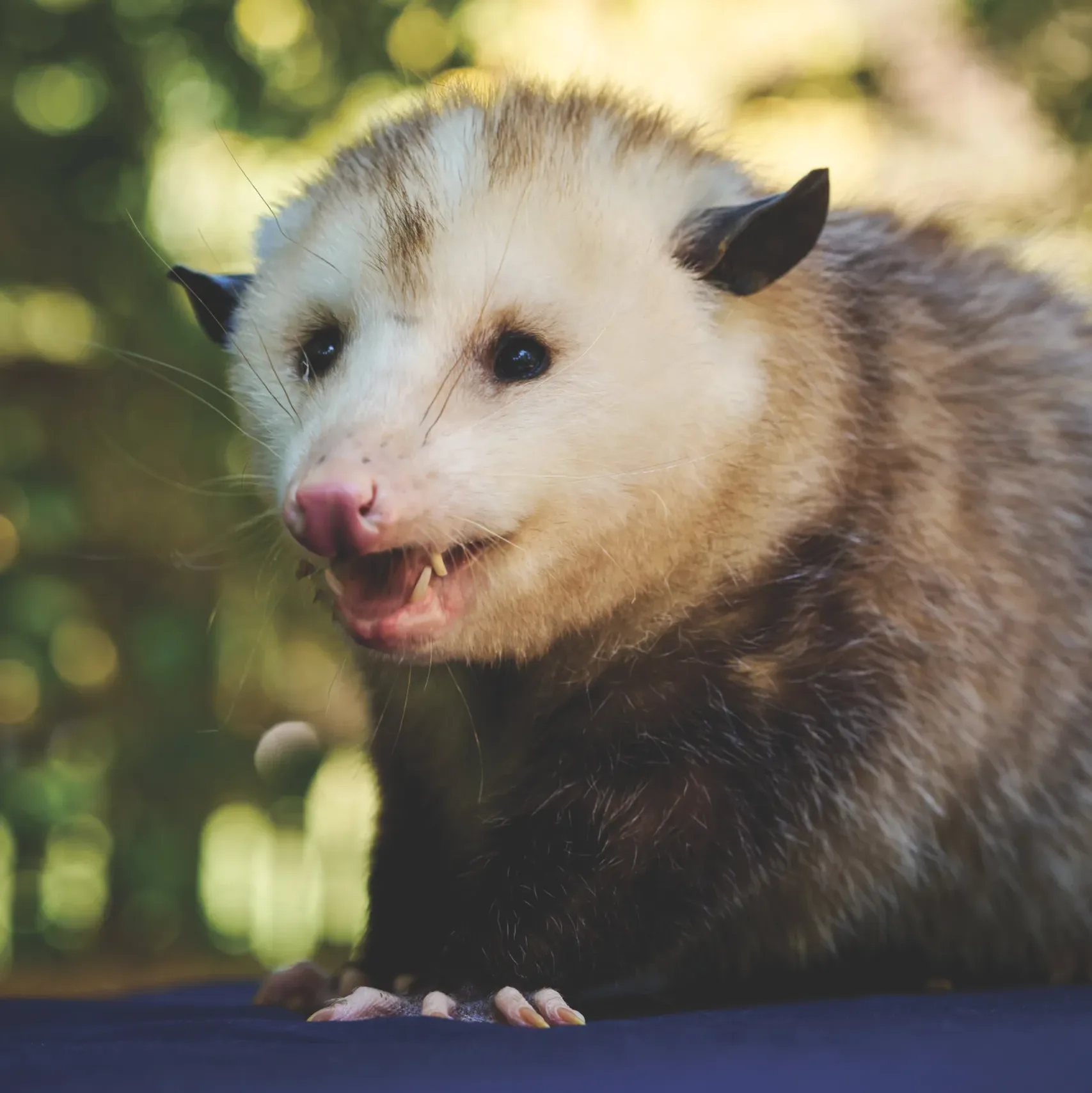
And it does. Most wildlife patients aren’t victims of natural disasters or orphaned like Double Green. Bradfield estimates that 99 percent of BRWC’s cases are human-caused: window and car collisions, glue traps, pet attacks, hunting accidents, or well-meaning but harmful interference, like feeding.
“We see a lot of horrific things every day, and it reminds you of the worst of humanity,” says Dr. Jen Riley, D.V.M., hospital director at BRWC. “But we also get the best of humanity. It’s that balance.”
One of Riley’s constant battles is treating lead-poisoned eagles. Intake exams show that more than 90 percent of adult eagles come to the center with elevated lead levels—not because they were shot, but because they’ve ingested fragments left behind in previously hunted game. The shards lodge in their digestive tracts and often require surgical removal. Still, Riley recalls a bright spot: A hunter who brought in a poisoned eagle and, after learning the cause, became an advocate for non-lead ammunition, even starting a Facebook group to spread the word among fellow hunters.
Leonard sees that kind of goodness in his neck of the woods as well. “We’ve had people call us in the middle of the night, saying, ‘Hey, I found this animal,’ at two in the morning, and then they drive three or four hours to bring it to us—and then three or four hours back home,” he says. “There are depressing examples that can make you cynical about the bigger picture, but it’s best not to get too bogged down in that, because there’s still a lot of good out there. There are a lot of people with big hearts.”
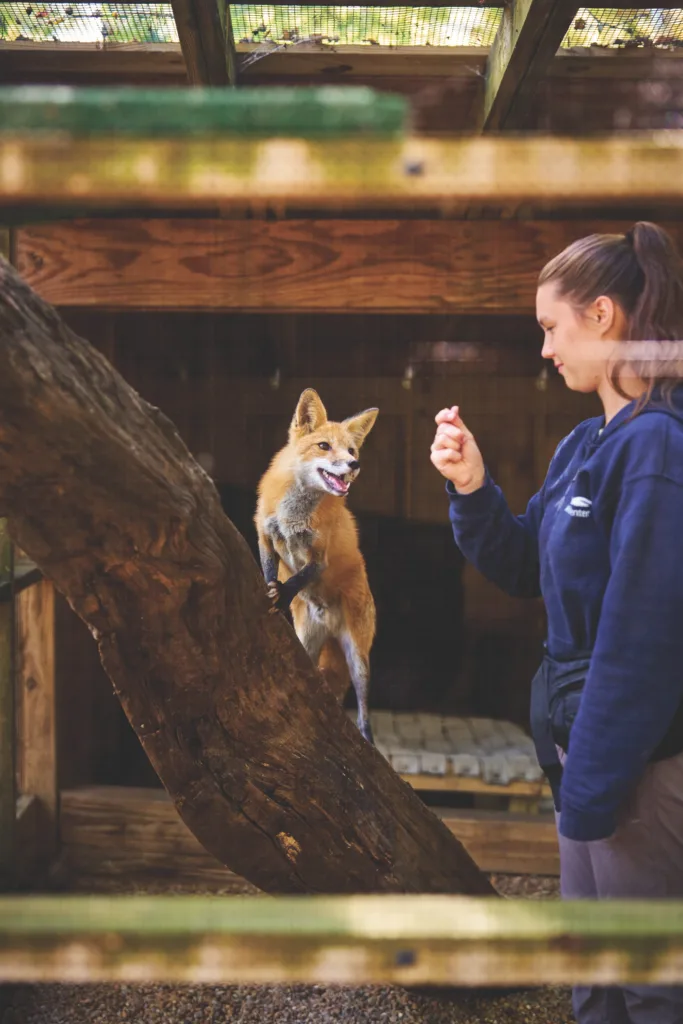
BRWC’s senior wildlife education specialist Alysa Everly teaches Jasper commands. Photography by Adam Ewing
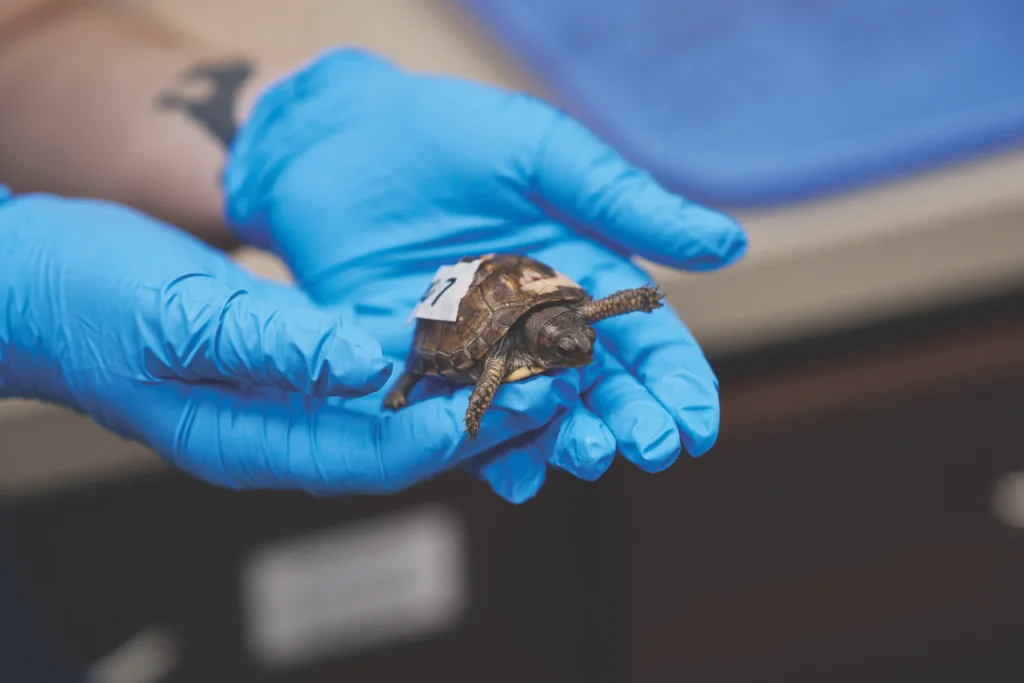
A small box turtle is being rehabilitated after its shell was cracked.
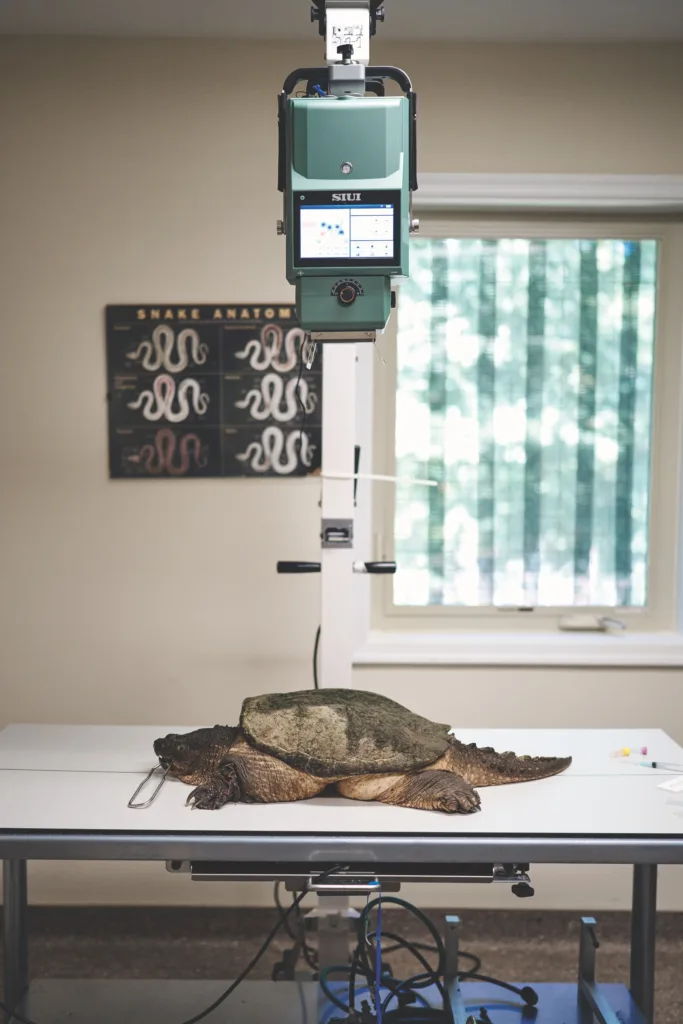
Weighing in at more than 30 pounds, the sleepy snapping turtle awaits X-rays.
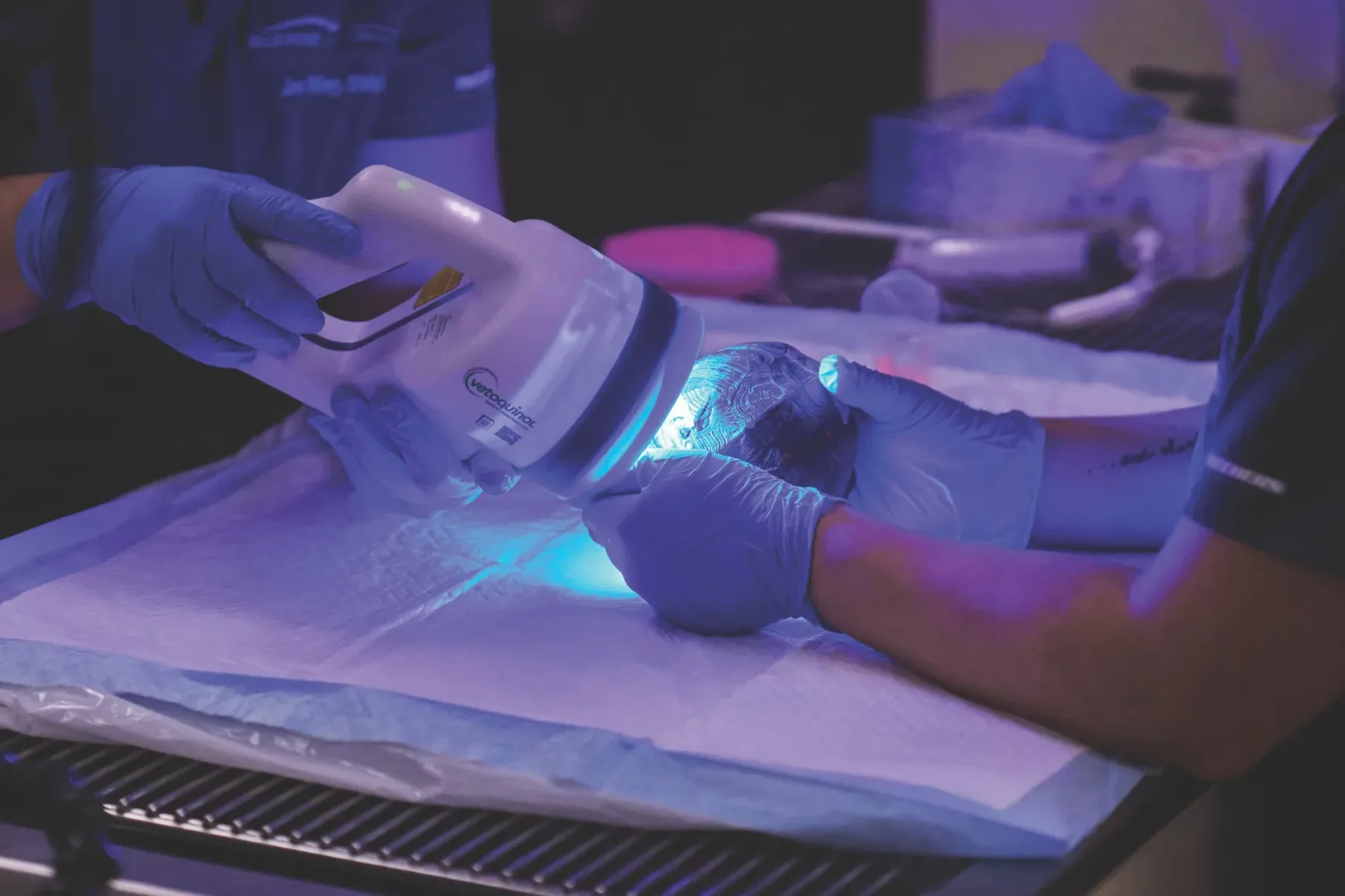
Ultraviolet light is used to rehabilitate damaged turtle shells.
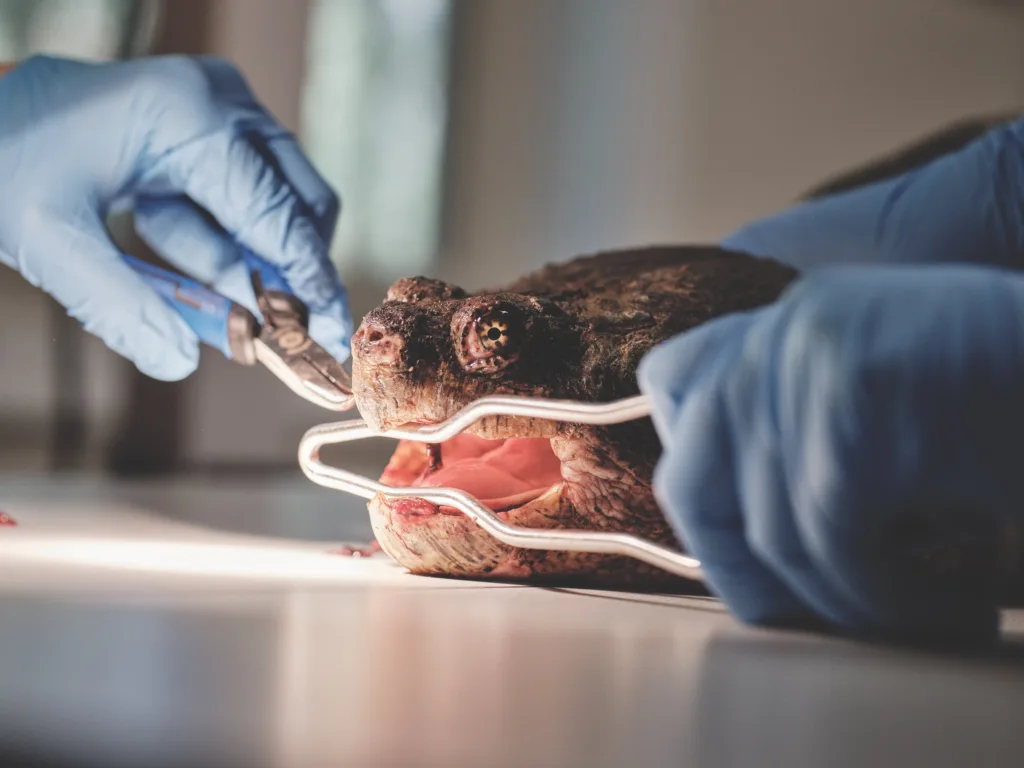
Dr. Jen Riley, assisted by the BRWC team, extracts a fishing hook from a sedated snapping turtle’s mouth.
Beginning the Goodbye
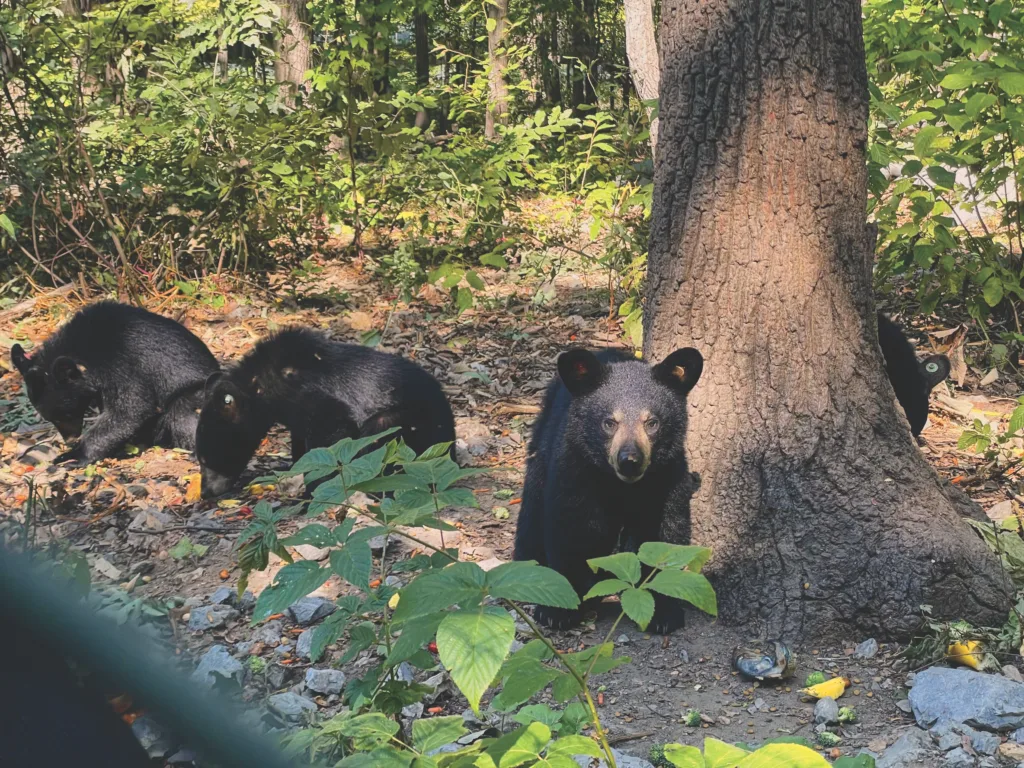
Big hearts swell most at goodbyes. For Double Green, that began with his move into WCV’s “big yard,” the outdoor habitat where cubs grow into yearlings, hibernate, and relearn wild instincts. Double Orange and five other rescued cubs joined him that spring and summer.
The yard has a live camera feed for both the public and staff. Olvera kept it up in her office for weeks, checking on the cubs as they vanished into the brush. Dunsheath, meanwhile, agonized as Double Orange spent his first days crying at the fence.
“I was like, ‘Oh God, he wants to go home,’” Dunsheath recalls. “That was hard, but he got over it. He’s good now.”
By then, bottles were gone. Food dropped from towers forced the bears to forage. It was bittersweet: proof they were stronger, healthier, more independent, and no longer in need of the hands that had nursed them there. Scrapes went unbandaged. Falls from trees went untended.
“They need to be independent,” Dunsheath says. “So it’s got to be tough love with them and tough love with yourself.”
The hardest day came April 2, 2025, when Double Green—just over a year old—was released into a remote forest by WCV’s rehab team and the Virginia Department of Wildlife Resources. Sedated for transport, he was inspected one final time by veterinarians before being set free. Staff had watched him grow from a six-week-old bundle of fur into a bear—long snout, massive paws, and all.
“He’s a very beautiful bear, actually,” Olvera says. “One of the largest cubs we’ve ever raised here.”
His personality grew just as big. He remained the foremost food lover, like he was when Double Orange first arrived. In the yard, he was the cohort’s dominant force, running the show. Upon his release, he sprinted for the woods, disappearing into the trees as if he’d never left. His fellow 2024 cubs followed in the weeks after.
“It’s like, ‘We did it!’ It’s very rewarding,” Olvera says. “But at the same time, we had them since they were tiny. And now they’re off to college. We won’t see them anymore.”
Those Who Stay
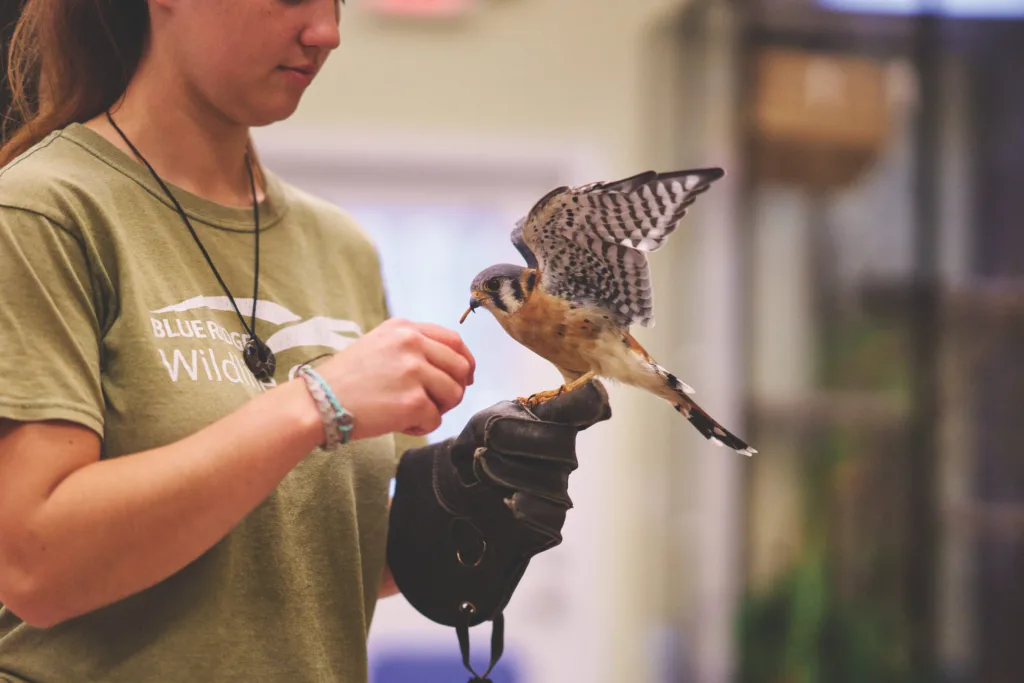
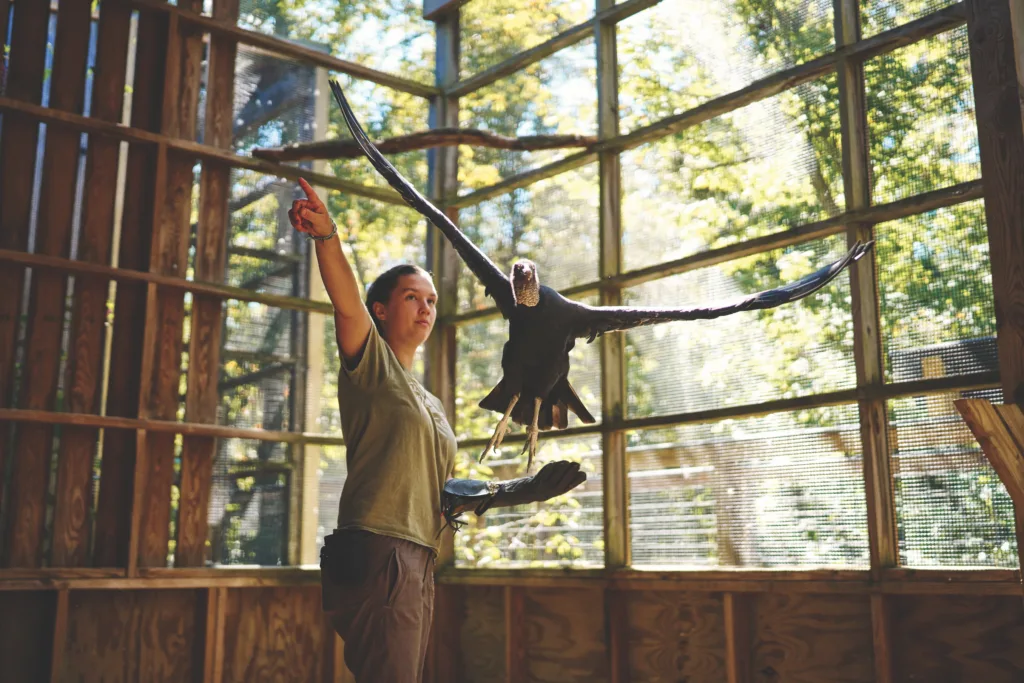
Not every patient graduates from wildlife center care. Some can’t be saved, and others can only be treated to survive in captivity. An imprinted, once illegal pet fox, a red-tailed hawk with one good eye, and a three-legged box turtle—all are real cases at BRWC. Their stories didn’t end there; each became a “wildlife ambassador,” helping teach the public what’s at stake when it comes to living alongside wild neighbors.
Ambassadors are a cornerstone at BRWC, the Wildlife Center of Virginia, the Southwest Virginia Wildlife Center, and others across the state. “Without education, research, and training, if all we did was care for patients and release them, it’d be a drop in the bucket,” says Bradfield at BRWC.
Those in the field say it’s working. In Roanoke, Leonard watches eyes widen when he introduces Tuskegee, a red-tailed hawk ambassador. “When you see a hawk up close—there’s nothing like it,” he says. Riley has seen the same transformation at BRWC. She recalls a 12-year-old who insisted a rat snake needed veterinary care after swallowing a ceramic chicken egg, overruling her parent. “Kids know so much, and that gives me a lot of hope,” Riley says.
Even aside from ambassadors, the centers never stay empty. There’s always a turtle with a cracked shell or an orphaned hatchling in need. The bear yard is no different—already, the WCV’s 2025 cubs are fattening for winter. Still, neither the team there nor Hankins, the firefighter who found him, will forget Double Green, once the smallest, most helpless cub, now a creature of majesty—king of the forest, as he should be.
“I certainly hope he has a long, happy life out in the wild,” says Hankins. “But I’m glad to have been a part of the story that got him there.”
Wildlife What To-Dos
It’s human instinct to see a lonely or injured animal and step in—but instincts can steer us wrong. Experts share tips for doing right by the wildlife near you.
- Call a rehabilitator first. If you find an animal in distress, “our first advice is always: call before intervening,” says Dr. Jen Riley at BRWC. Human interference can harm animals—like removing a baby from a mother who more than likely intends to return. Feeding certain wildlife can also cause harm or trigger state rabies protocols. “It’s better to do nothing than to do the wrong thing,”
Riley says.
2. Keep domestic cats indoors. Riley reports that 15 percent of cases at BRWC are cat attacks. Cats threaten delicate ecosystems by killing or maiming native species.
3. Clean your bird feeder. Dirty feeders can spread avian diseases. Clean them regularly, or instead opt to plant native flora for birds to enjoy safely.
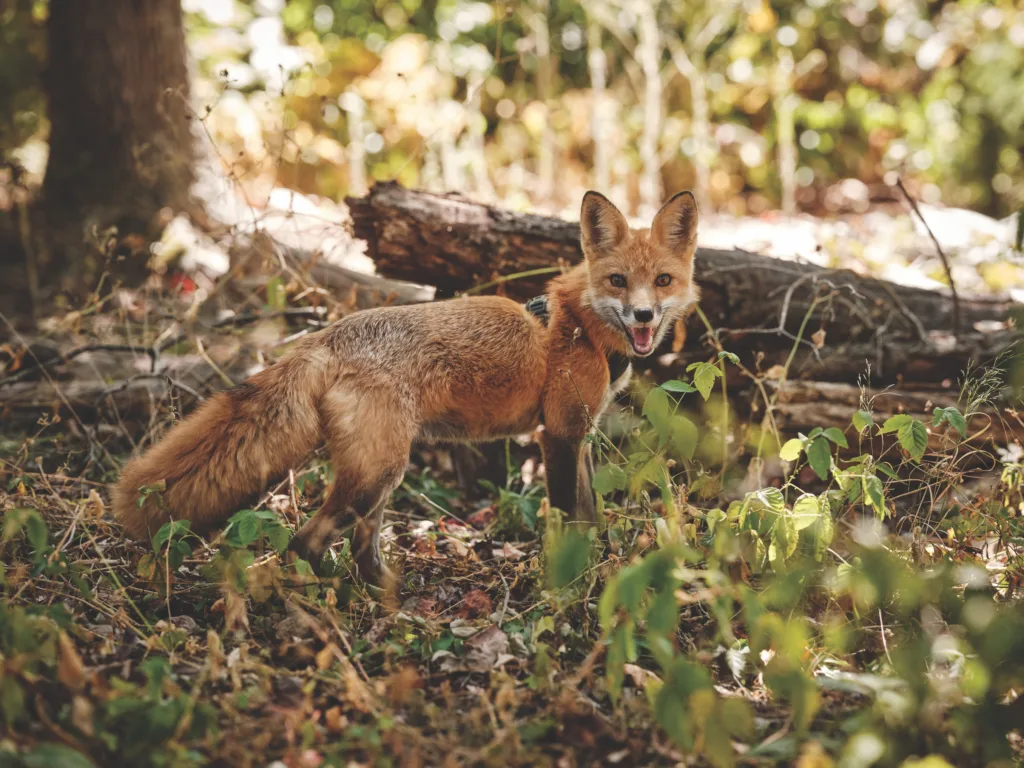
4. Don’t keep wild animals as pets. That backyard fox may be cute, but feeding, petting, or bringing it inside is illegal in Virginia and harms its survival skills. “It imprints, essentially, and loses the ability to hunt and fend for itself in the wild,” says Chester Leonard of the Southwest Virginia Wildlife Center.
5. Take care of yourself first. “People who love animals will do almost anything to save them, but please be careful,” Leonard says. That means thinking twice before sprinting across a freeway and wearing gloves when you must handle wildlife.
Find a wildlife rehabilitator near you at DWR.Virginia.gov/Wildlife/Injured/Rehabilitators.
Outfoxing a Fox
By David Walters
Like humans, baby animals bond closely with those who feed and care for them. This process, called imprinting, can prevent wild animals from being reintroduced to the wild.
The Richmond Wildlife Center (RWC) knows this all too well, caring for 300–400 animals a year, though demand tops 6,000–7,000. They take extreme steps to remove humans from the picture when caring for injured and orphaned infants. When same-species surrogates are not available, staff disguises themselves, whether it be winged or four-legged, so animals don’t bond with humans.
In March 2024, a newborn fox kit arrived. Rescuers mistook it for a kitten as it was only a day or two old. Executive director Melissa Stanley, realizing the human contact it had already received, quickly put out a social media request for a fox mask. Her wish was granted. By the next day, she wore it while feeding the kit so it would associate sustenance with its own kind—albeit the largest fox it will ever see.
With demand so high, RWC is nearly halfway to its fundraising goal to build a larger facility for the Greater Richmond area. RichmondWildlifeCenter.org
This article originally appeared in the December 2025 issue.