


If you’re fortunate enough to live within the kind of habitat that supports a lot of birds, then you know the pleasure of that morning chorus of cheeps, chips, chirps, whistles, squawks, tweets, and more that signals the fullness of summer.
And within that chorus might be hiding in plain sound a bird that’s common throughout the Commonwealth and yet surprisingly rarely seen.
The great crested flycatcher is one among a large and diverse family of more than 400 bird species known collectively as the “tyrant flycatchers.” And for its preference for life up in the leafy canopy—not to mention a certain feistiness of spirit—this particular flycatcher is known as the “treetop tyrant.”
Because great crested flycatchers do spend their lives up high, you might have them around all summer. But you might never be aware of their presence unless you can identify them by ear. “We have them everywhere in Virginia,” says avian ecologist Dr. Ashley Peele. “But it’s surprising how rarely you see them.”
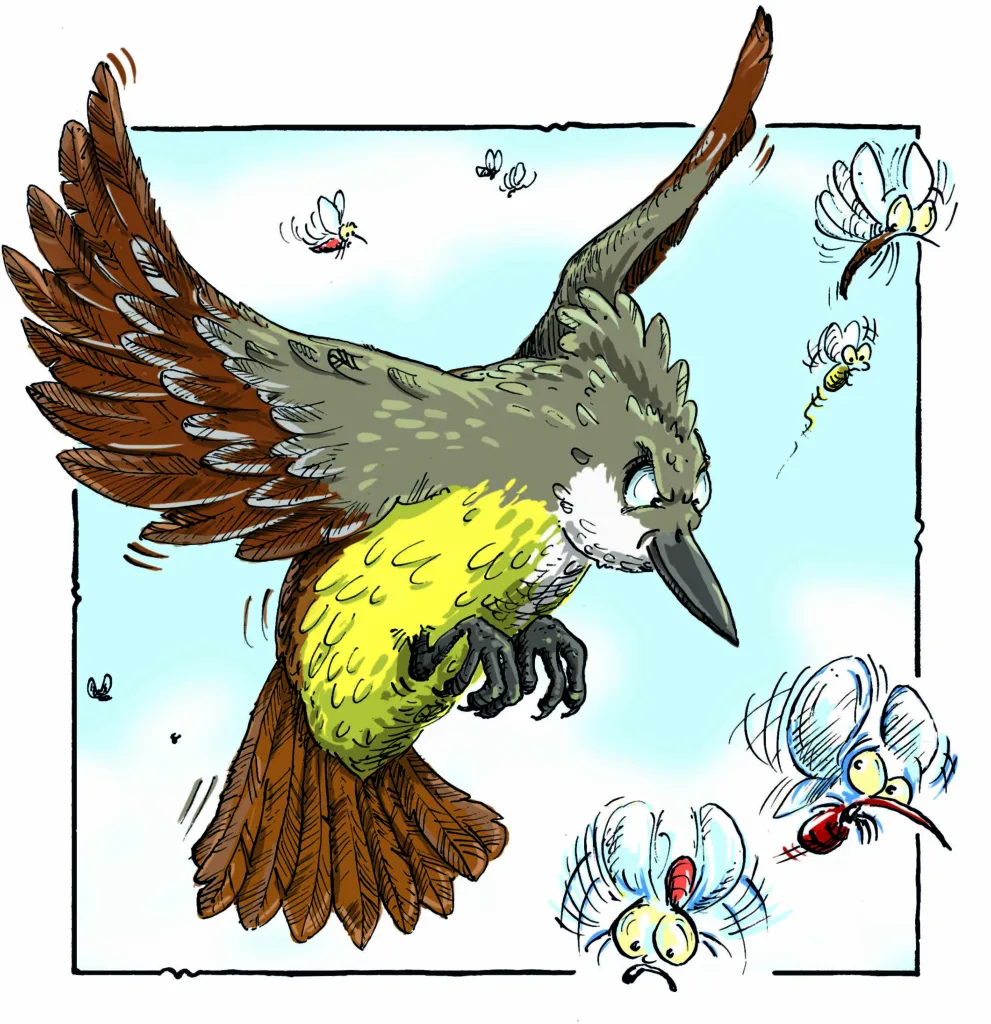
The “great crest” to which their name refers is a kind of distinctive, feathery mohawk atop their heads, and it’s a shame that these birds are so seldom seen, because they are attractively arrayed “with rich reddish-brown accents and a lemon-yellow belly,” as the Cornell Lab of Ornithology’s All About Birds describes them.
The “flycatcher” part of their name points to their preferred diet of insects, and, according to Peele, they are excellent aerial hunters that snatch their prey while in flight. And great crested flycatchers go after real mouthfuls—butterflies and cicadas, moths and katydids, spiders and tree crickets. The snap of their bills while hunting, says Peele, is another thing you can listen for. “They have such big bills, and they are using them to grab insects as they are hunting, and when they miss, you can hear that really loud bill clap.”
So how about the “tyrant” part of their name? The birds, says Peele admiringly, are “crazy aggressive” (“assertive,” says All About Birds diplomatically), both in their hunting and defensive behaviors. She’s captured a few in mist nests over the years, and while some birds will sit quietly in the hand once captured, that is not the case with a great crested flycatcher, which will let you know in no uncertain terms that it’s not putting up with this nonsense. She recalls another time when she heard a ruckus overhead while out doing a bird survey. “I heard this screaming, and it was two great cresteds fighting off a squirrel trying to raid their nest. I could see them dive-bombing this squirrel. They were incredibly aggressive in their nest defense.”
Speaking of nests, the birds like to occupy “secondary nest cavities,” which is to say a space that might previously have been occupied by an owl, squirrel, or woodpecker, and again preferably up high. An interesting item about their nesting habits is their documented use of shed snakeskins in the nests. Some researchers in Florida, says Peele, found that the choice might be more than decorative. They tested the theory that this nest material served to ward off predators, and found indeed that nests with snakeskin were subject to less predation by small mammals than those without.
Great crested flycatchers are migratory birds, spending the breeding season here from roughly April through September before flying south in the fall to winter grounds in Central America and the very northern part of South America. A fascination with how migratory birds, including the recently hatched young birds, know where to go and how to get there is one of the things that captured Peele’s interest as a student and drew her towards her field. Today, she is a science integration coordinator for the Appalachian Mountains Migratory Bird Joint Venture, an organization that works with hundreds of partners—“anyone with a stake in birds and Appalachian ecosystems”—to help deliver healthy, sustainable habitats and populations for migratory birds throughout the Appalachian region. The good news about great crested flycatchers, she says, is that while there have been documented population declines since the 1980s, they remain a common bird.
So the next time you hear a mysterious whee-eep! echoing from the treetops followed by the sound of aggressive bill-clapping, you’ll know you’ve got yourself a feathered mohawk-wearing tyrant holding court in the canopy—even if you can’t actually see the little showoff.
This article originally appeared in the October 2025 issue.