

There is a golden retriever in Richmond who has solved a problem that has plagued mankind since the invention of interior design: the problem of things being where you left them. His name is Duke, he is 11 years old, and he has decided, with supreme confidence, that everything in the house belongs in his dog bed.
Not some things. Everything.
It began, as most great careers do, modestly. Duke arrived in his new home, looked around at the reading glasses on the end table, performed some kind of internal cost-benefit analysis invisible to the human eye, and walked off with them. Calmly, confidently, like it was the most natural thing in the world. His people, Cathy Hoyt and her husband Nelson—who had lived under the quaint assumption that objects stayed where you put them—watched this happen. They said nothing useful. What is there to say?
What followed was less a habit than a philosophy. Duke moved on to fine china, carrying teapots and cups to his bed with the delicate precision of a Sotheby’s handler. He took a 12-pack of toilet paper. He made off with books, magazines, a laptop in its bag, and even art off the walls. He eventually took an entire lamp. Not a lampshade—a lamp. One can only imagine Duke hauling it down the hallway with the focused dignity of someone who has somewhere to be.
Cathy, for her part, has responded to all of this with a composure I find genuinely aspirational. In Instagram video after video, her calm voice floats in from off-camera: “Duke, honey, what are you doing?”
Behavioral experts, confronted with Duke’s particular proclivity, offer the clinical term “resource guarding”—which is the scientific way of saying that Duke has strong opinions about ownership, and those opinions are that ownership is his. Previous homes found this challenging. A foster parent had her entire computer bag relocated to the sofa, where Duke cuddled it. An adoptive family returned him after he snapped at a child who tried to reclaim an item he was particularly partial to. This is understandable. You do not take things from Duke. Duke takes things from you. These are the terms.
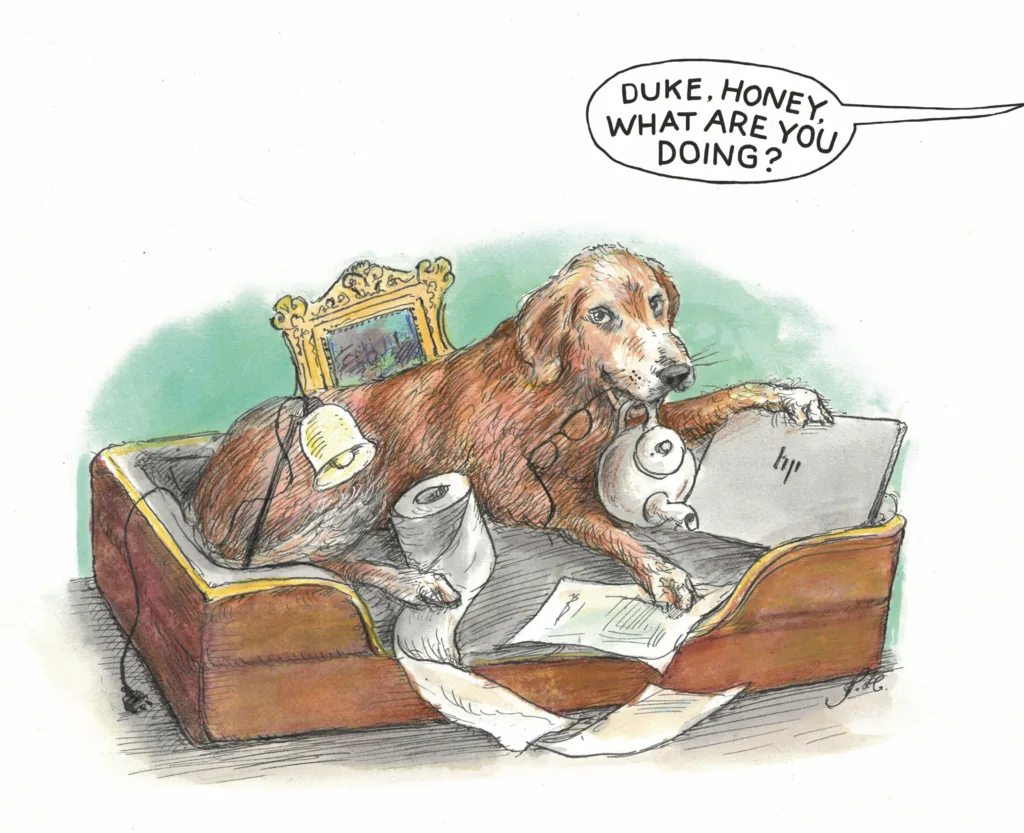
What I find quite extraordinary is the curation of it. Duke is not an agent of chaos. He is not knocking things off shelves for sport. Duke selects. Duke carries. Duke arranges. His dog bed, at any given hour, might hold a picture frame, a creamer, three National Geographic magazines, a platter, and a paper towel 6-pack—a still life that would make a Dutch master envious.
Cathy began filming him to show Duke’s vet and ended up posting her reels to Instagram; they’ve garnered millions of views. He’s achieved celebrity status, with his escapades appearing in People Magazine and The Washington Post. And that feels exactly right. We have always suspected that dogs are up to something when we’re not watching, and Duke simply removed the mystery. He is not about acquisition. He is building something.
Richmond’s most prolific golden-fleeced kleptomaniac shows no signs of slowing down. At a decade-plus, Duke remains fully committed to his life’s work—still selecting, still carrying, still arranging his ever-expanding collection with curatorial authority.
But here is what I keep returning to. Duke spent years moving from home to home, a dog that other people found too difficult, too strange, too much. He arrived in Cathy and Nelson’s house already old, already set in his ways, already absolutely certain about what he needed. And what he needed, it turns out, was not obedience school, behavior modification, or a firm hand. What he needed was a lamp. And a teapot. And a copy of Bill Bryson’s A Walk in the Woods. And someone who would stand in the hallway with a camera and ask, not accusingly, but with bottomless affection, “Duke, honey, what are you doing?”
He’s making sure, is what he’s doing. He’s making sure that this time, when he falls asleep, everything he loves will still be there in the morning.
This article originally appeared in the June 2026 issue.