
For over a decade, Sheila Heinze lived in a big house at the end of a cul-de-sac in Leesburg. She built a vibrant life in town, but there was always a pull toward the country. As her nest emptied out, she looked westward, searching across Virginia for the right piece of land to start her next chapter.
The landscape itself mattered more than the property. Heinze was confident she could turn the right piece of acreage into her home. Her one requirement? A place that she and Elizabeth, her beloved horse, would thrive.
At the time, properties were being sold off right and left to wineries, cideries, and breweries. What she did find was square chunks of farmland—places she knew Elizabeth would struggle due to a long list of equine allergies.
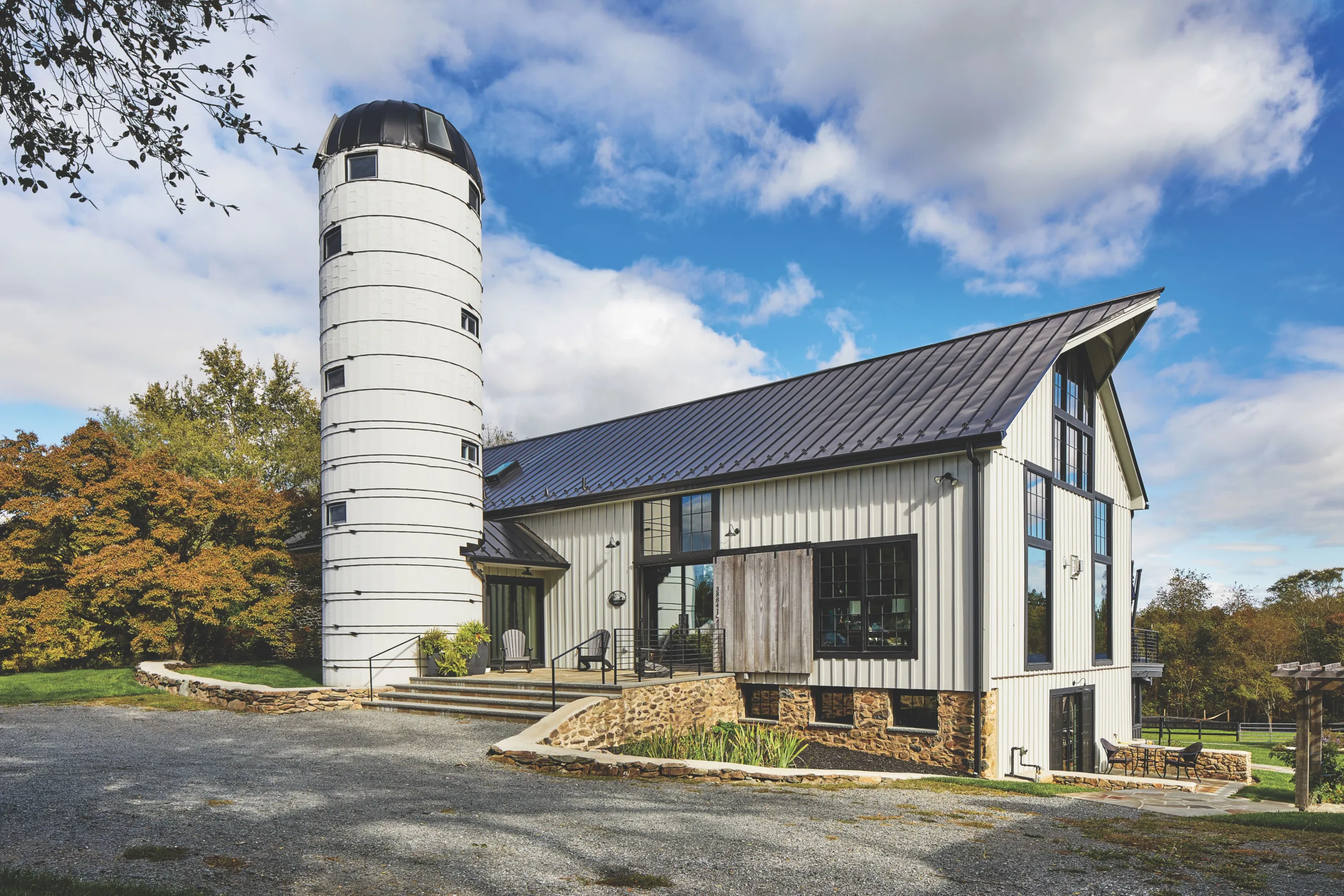
But, in 2019, when a pocket listing in Hamilton came up with hills, trees, and a babbling stream, Heinze knew she’d found potential just 15 minutes from her family, friends, and life in Leesburg. For all the 32-acre property offered in natural beauty, however, it lacked in infrastructure. The “home” was a former dairy barn, with half of the building constructed in the 1780s and the other half added in the 1840s. In the 1970s, it was converted to a house.
It takes a specific personality to believe that a dairy barn is the place to call home, and it’s no surprise that Heinze immediately connected with the previous owner as a kindred spirit. “She was a hoot! She was an amazing woman who’d been there for 40 years and had stories to tell,” laughs Heinze. It became her calling to purchase the home and finish out the projects the prior steward of the property had envisioned.
Heinze was met with skepticism from friends and family when it was revealed she’d bought a dairy barn, particularly one that was unfinished, dilapidated, and overrun with critters, including snakes. But, despite her years spent raising her family on that Leesburg cul-de-sac, Heinze was no stranger to restoring old homes. She’d previously renovated a late 1800s home in Catonsville, Maryland, and an 1800s row home in Bolton Hill in Baltimore, both of those tackled with her late husband by her side. This was her first time diving in solo, but her confidence and her ability to trust her own gut was her best asset.
One of those most surprised was her interior designer, Sadie Johnson, designer and partner at Maryland’s Emerald Hill Interiors. The two had collaborated previously, on a Victorian in town and a home on Lake Anna, but, at the time, they had their sights set on straightforward renovations to her
current home.
“Sheila called me late one night, and said, ‘Guess what! I bought a farm! It failed all inspections, and I’m so excited!’” recalls Johnson. “I said, well, that’s not a bathroom renovation.”
Snakes aside, Heinze was confident that as long as she assembled the right team, this was her house. Johnson was tasked with finding an architect who could take on the challenge, and Bethesda-based Rill Architects rose to the top, particularly given their recent work turning another barn into a home. Gene Davis, owner of Arise Builds in Round Hill, and Wildwood Landscape in Purcellville were brought in to complete the team.
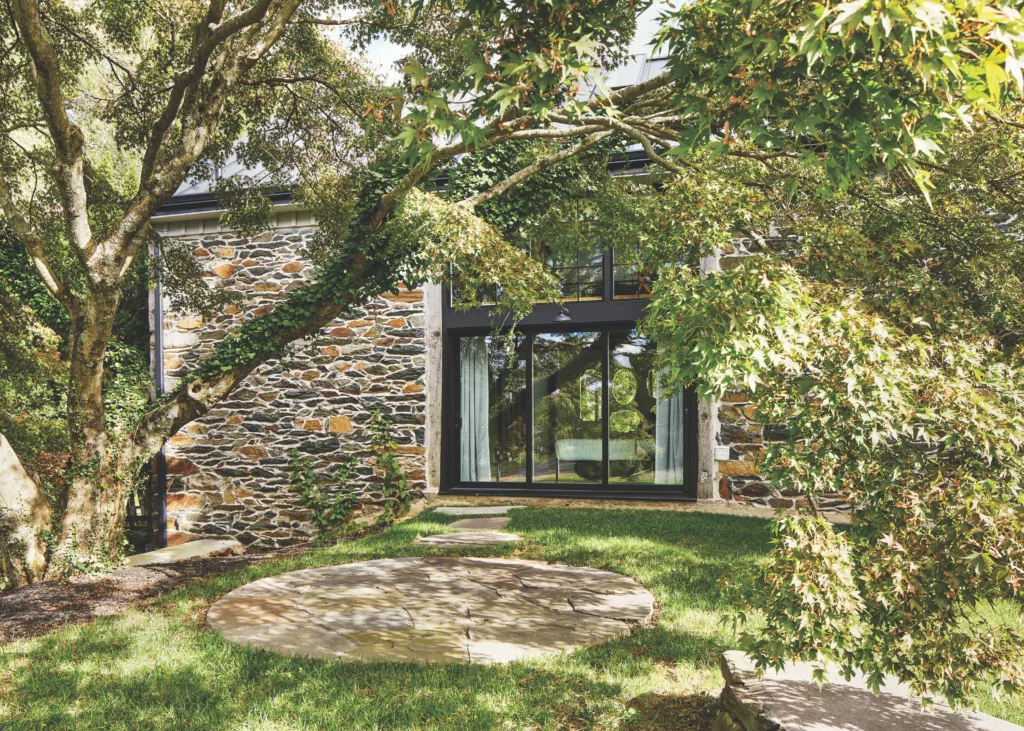
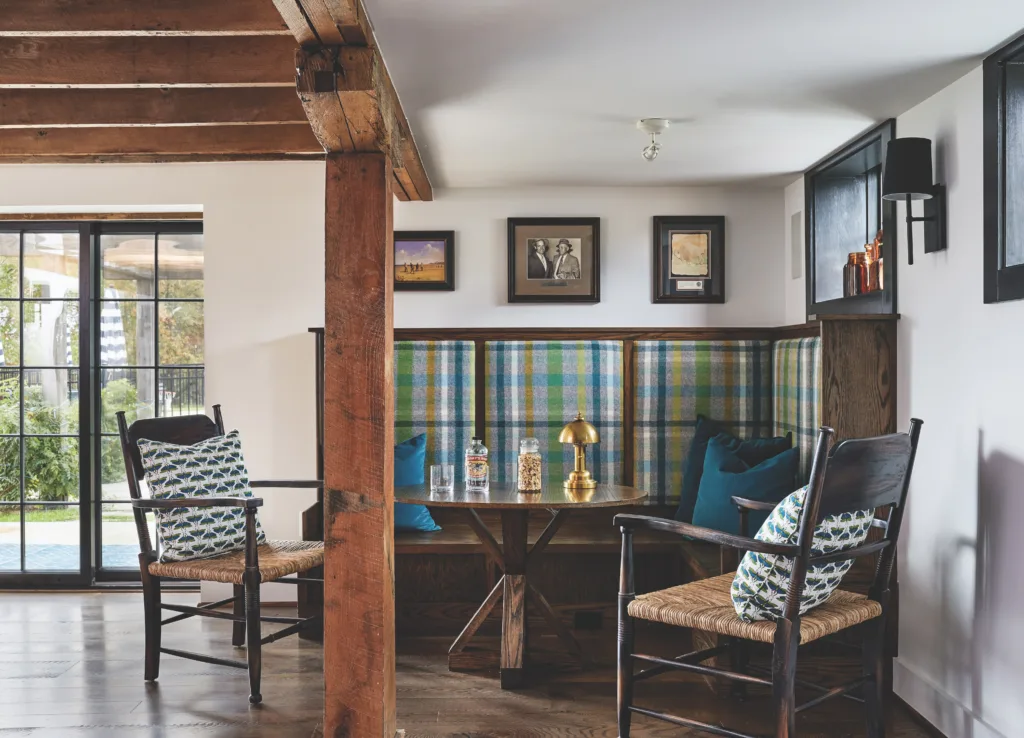
Sliding glass doors lead outside to a small shaded patio.
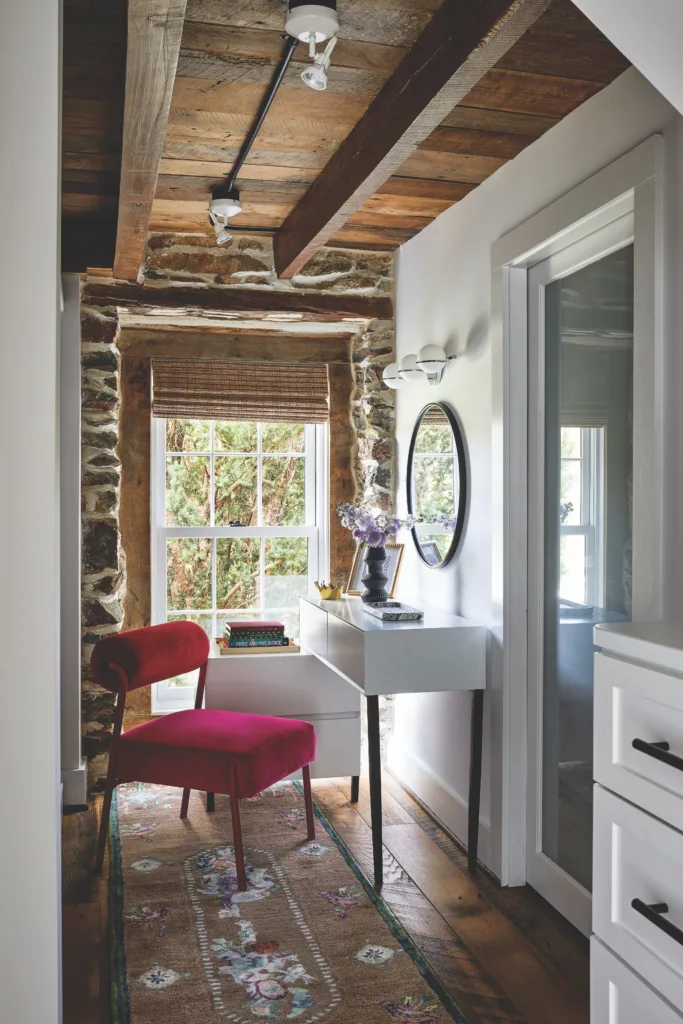
A cozy nook provides the perfect spot for a vanity.
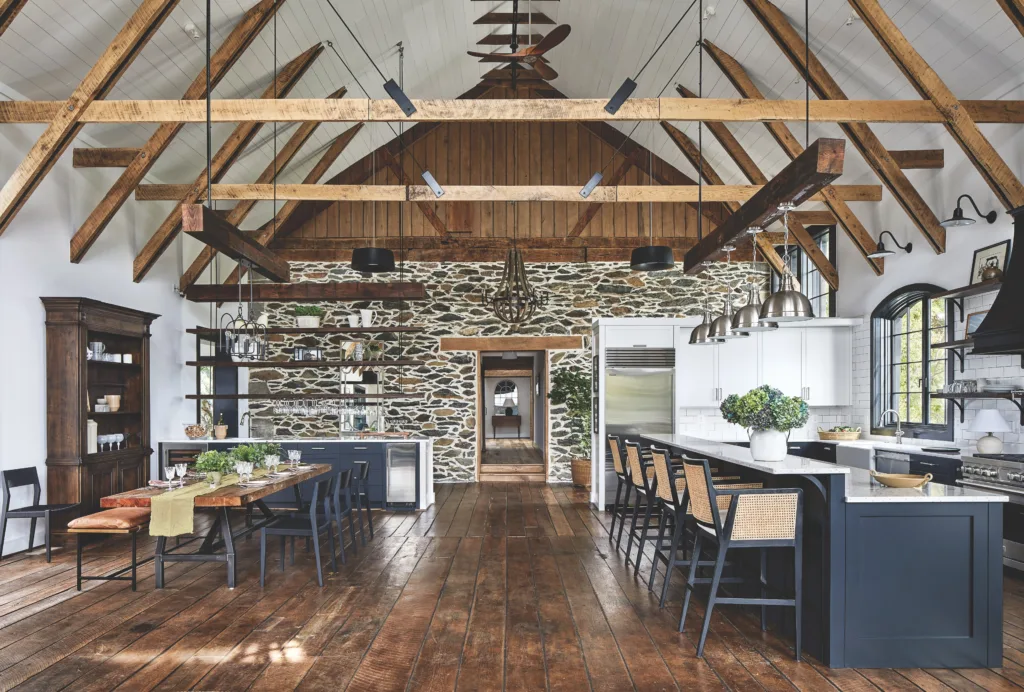
Together, their goal was to bring Heinze’s vision to life, and said vision was almost exclusively informed by the whispers of the structure itself. As Heinze puts it, she wanted to let the skeleton of the house speak, from its original wood beams to its stone walls, still hiding behind concrete with two-century-old bits of hay filler intact.
Working within a space where the structure is the architecture is a specialty of Jim Rill, AIA, principal at Rill Architects, and it’s why his firm proved to be a worthy collaborator. “You don’t cover up the structure. You celebrate it .… but with the understanding that walls do need windows,” says Rill.
Heinze imagined a space where everything indoors worked with the outdoors, and those windows were one of the first hurdles bringing that to life. Fortunately, post and beam barns often have large expanses of non-load-bearing areas, and Rill popped in doors and windows wherever possible to form that interior-exterior connection.
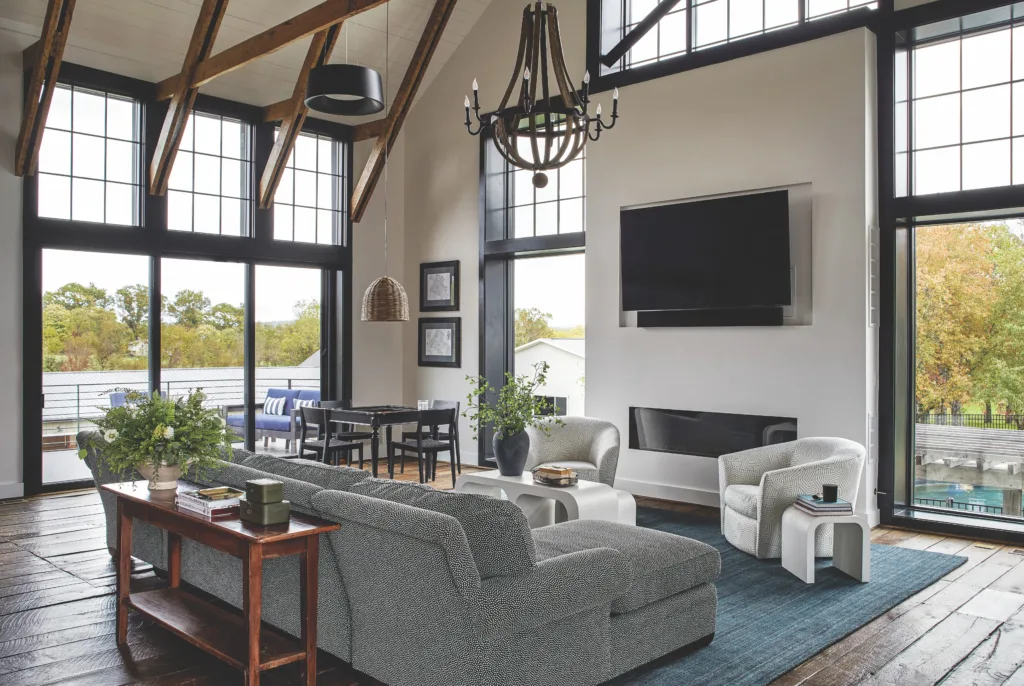
“We wanted to make it luxurious, while exposing historic timbers to maintain the sense that it’s a barn,” says Rill, who carefully walked a line between cozy and expansive. “It feels like an open pavilion, but with modern heating and cooling.”
When attention turned to the design, Heinze knew she wanted simple colors that would showcase both the original elements and the stunning views outside. She was as willing to recover pieces as she was to find modern elements, and she entrusted Johnson as a collaborative partner in that goal.
“Sadie knows how I like to work. It’s an easy relationship. I don’t need to spend a fortune on everything being custom. I love getting a few really special pieces, then creating around that. I like the quest,” explains Heinze.
Their work started with the palette—white, black, and wood. The idea was built on the lightness of the white walls, drawing the eye up towards the wood beams, while black would frame the view to the outside. These colors define spaces like the kitchen, which has ceilings soaring to 26 feet high. Within the kitchen, the furniture and appliances had to command a presence while keeping the room functional yet welcoming. The range hood becomes a focal point, while a custom table built for the dining room adds warmth and echoes the patina of the wood in a tall wood china display. A bowed window creates a necessary sense of softness through its sleek curves.
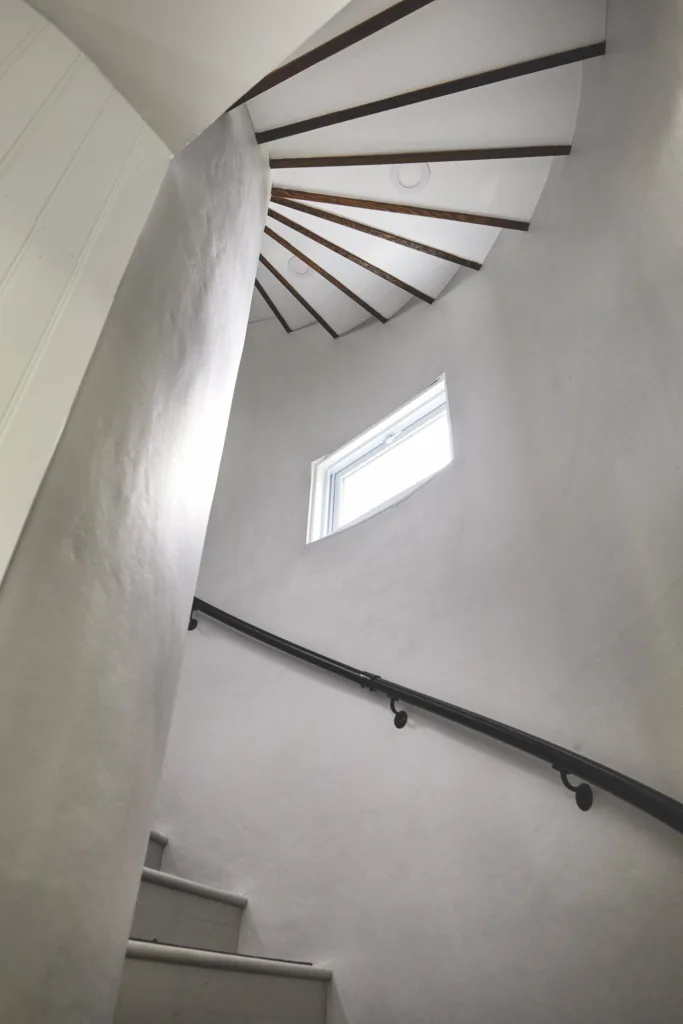
A circular staircase travels up the silo.
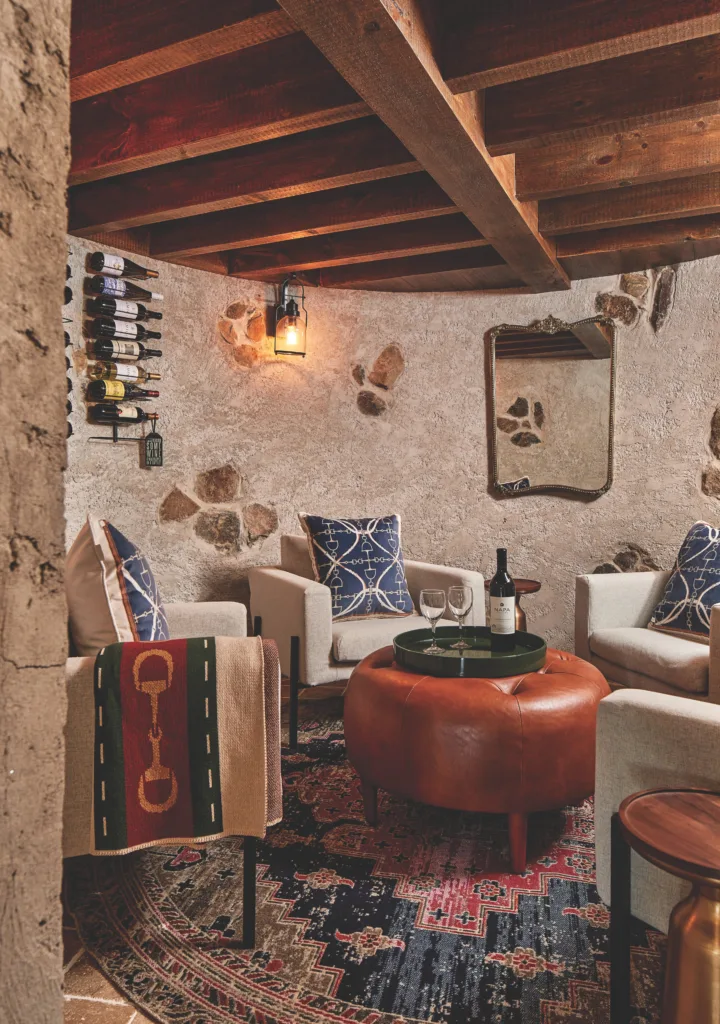
At the base of the silo is an intimate room with concrete walls where Heinze hosts wine tastings.
Nothing about the home feels stuffy, which is no surprise given the way Johnson describes Heinze. “She’s the woman you want in your corner at all times, and she watches over everybody. She’s a gift.”
Her generosity of spirit is apparent in the home, which is designed for welcoming loved ones into its six-bed, six-bath, and two half-bath footprint. Beyond the bedrooms, which were cleverly created from oversized horse stalls, there are multiple spaces for entertaining. First, there’s the bar. “Being Irish, I’d always wanted an Irish pub. So we made an Irish pub,” says Heinze.
Then, there’s the wine tasting room tucked away at the bottom of the silo, with its plaster and stone walls, warmer palette, and travertine stone detailing. It’s a welcoming space that wasn’t welcoming to full-size furniture. As Johnson explains, “The door opening was only 21 inches wide. We could only select furniture that could be broken down and reassembled within the room. But this has become the space where everyone hangs out.”
The family room introduces a navy blue and peacock palette informed by an existing piece of art from Heinze’s collection. The U-shaped sectional invites a large group of family and friends to sit and stay a while.
Another room with color as a star is Heinze’s bedroom, where Johnson jokes that the goal was fresh, bright, and feminine. She wanted layers, more layers, and a happy, light look that wouldn’t compete with the rest of the house. There are flowers in juxtaposition to the more masculine textiles throughout the home.
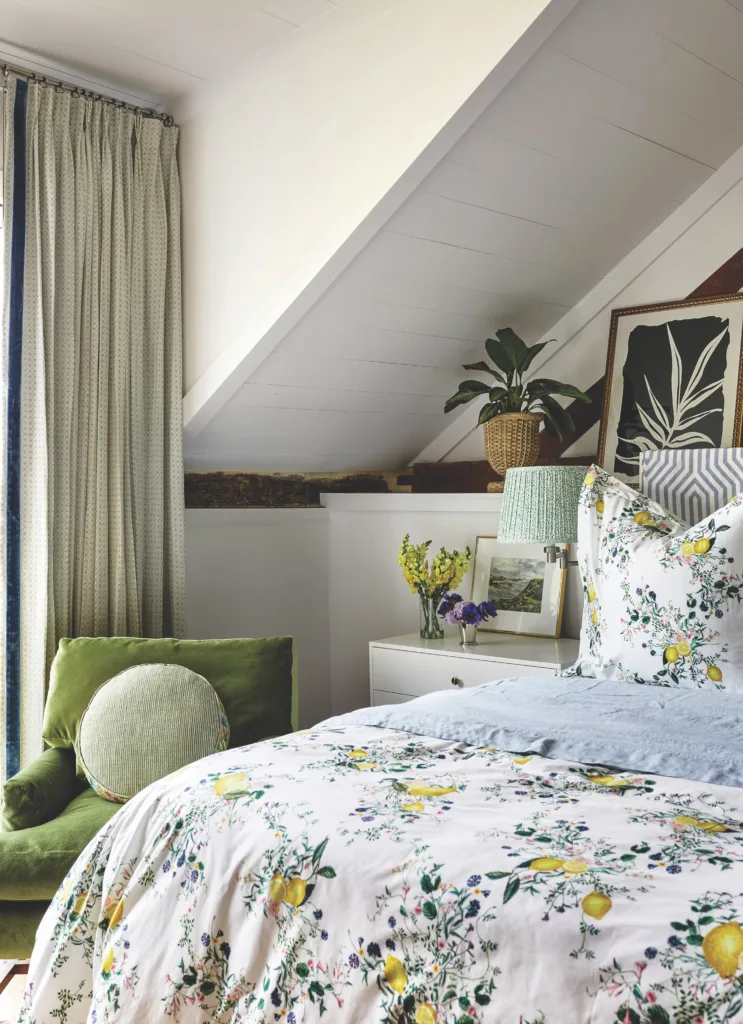
A bedroom in the former hayloft gets a lighthearted treatment from “Positano” bedding by Monique Lhuillier for Pottery Barn.
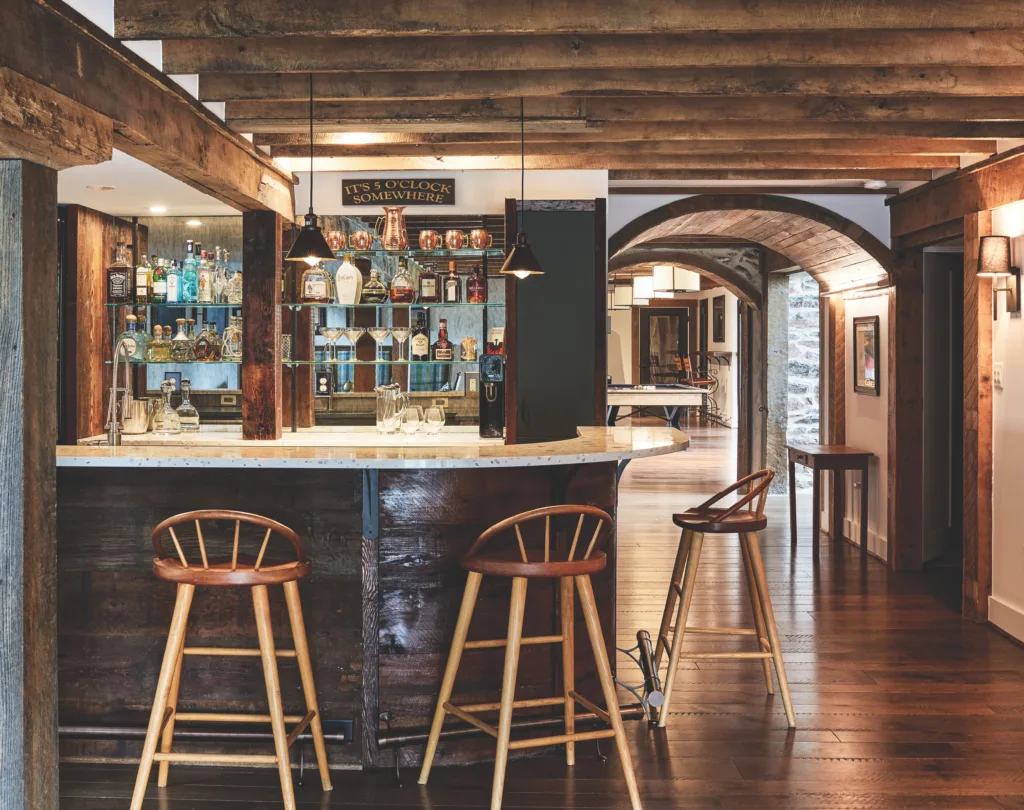
On the lower level is a custom-made bar. Beyond is a barrel ceiling passageway that leads to a gameroom.
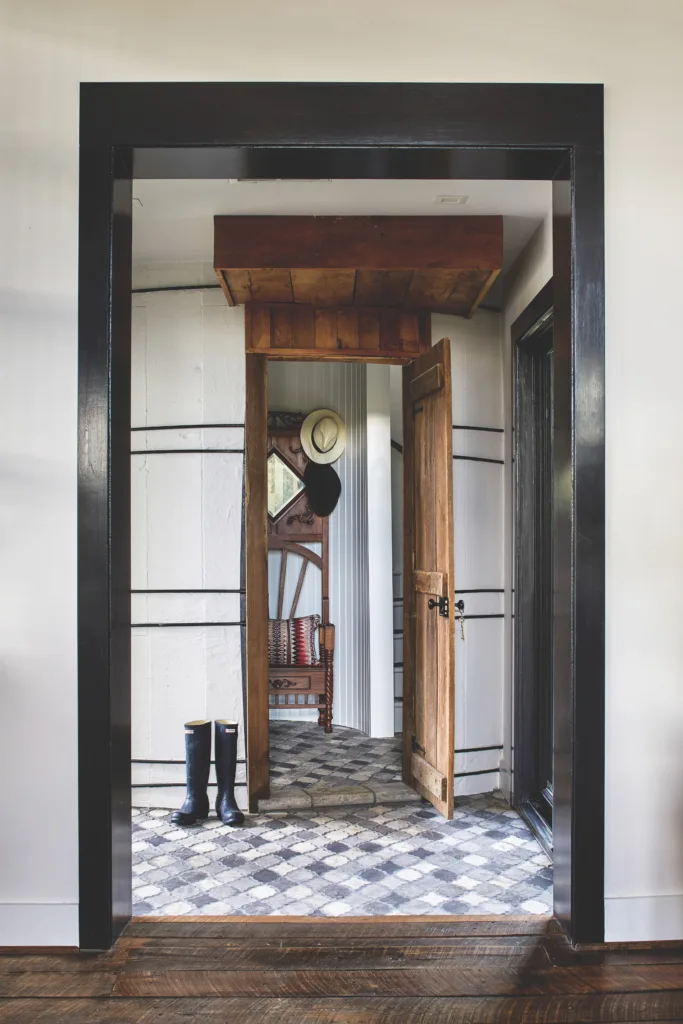
The passage between the main house and the silo is a mudroom and features concrete tiled flooring that leads to the spiral staircase.
These spaces, like much of the house, have evolved over time, and they will likely continue to do so. There is nothing stagnant about a structure that is now going on three centuries, and Heinze is committed to continuing its legacy.
“This is the last major home that I’m going to do like this, and every decision is for me, the animals, and the property. I trust my gut. I trust my team. I was open and receptive to the house and responding to what it needed,” says Heinze. “This home is alive, inside and out.”
This article originally appeared in the December 2025 issue.