

It was seemingly unremarkable leg pain that would eventually launch Oakton High School senior Khartik Uppalapati into a journey that would span international advocacy, Ivy League research, and a speech at the UN—before he even graduated. At the time, he was a healthy 12-year-old, and his family assumed it was a strain from exercise. But it persisted. Doctors suspected everything from fractures to sprains before discovering a noncancerous tumor in 2021.
At the root of the issue were two rare conditions neither Khartik nor his family knew about: arteriovenous malformations (AVM) of the hip—abnormal connections between arteries and veins—and lymphedema, a lymphatic disease that causes swelling due to a buildup of fluid. Both affect fewer than 200,000 people in the U.S. and are classified as rare diseases.
“It was traumatic to go through that whole cycle,” says Khartik’s father, Ramesh Uppalapati. “What was more painful was the hospital visits that we had to make before they diagnosed the actual condition.”
By the time a diagnosis was reached, the family had seen almost eight doctors and traveled to Children’s Hospital of Philadelphia several times.
Even with an answer to the mystery, Khartik felt unsteady. The conditions were uncommon, and accessible information was scant. Most of what he found was geared toward doctors, not patients—especially not young ones.
“Very soon [after his diagnosis],” Ramesh recalls, “he channeled his energy into more positive things.”

Remote schooling gave Khartik time to dive into coding and research. By 14, he’d already published papers and begun working with researchers at the University of Pennsylvania, later adding the University of Missouri, Harvard, and Princeton to his resumé. The more he learned, the more he wanted to share. When pandemic restrictions eased and he could attend conferences on rare diseases, he noticed something striking: He was often the only young person in the room—despite the fact that almost half of all people with rare diseases in the U.S. are under 18.
“I was thinking, ‘Why are there no rare disease organizations that exist that are fully led by the youth or even just youth-focused in particular?’ That gap was what I wanted to fill in,” Khartik says. “I tried to figure out if there was any way for me to create a network of students who have rare diseases, especially mine, who want to connect with each other and take action.”
So Khartik and a few like-minded students from his Northern Virginia community founded RareGen, a nonprofit startup and advocacy group supporting young people with rare diseases through community connections, education, outreach, political advocacy, and research.
Between classes, the team drafted policy recommendations and submitted reports to international bodies like the UN—only looping in their parents when it came time to officially incorporate the nonprofit in Virginia.
“We react to anything that he asks for, but he is self-driven,” Ramesh says. “He doesn’t discuss his ideas with us. He doesn’t need vetting. I think we have let him grow in an environment where he’s able to make his own decisions.”
In 2024, when he was 15, Khartik told his parents he was planning to travel to Bangkok, Thailand, to speak at the Eighth Session of the UN Committee on Social Development that fall. They thought he was joking. But he and his RareGen peers handled the logistics, prepared talking points, recruited chaperones—and made it there.
The global attention RareGen garnered was a milestone. But eventually, Khartik says, they realized that “at a certain point, global advocacy can only do so much.” To make a more immediate impact, they began focusing locally—meeting with Maryland and Virginia lawmakers to discuss rare disease policy and contributing to more than 15 state senate resolutions.

Khartik holds his 2025 Princeton Prize in Race Relations. Photo by Scott Suchman
Today, RareGen has eight active chapters across Fairfax County. The organization empowers young people to lead the charge—hosting workshops, running webinars, and sharing personal stories to raise awareness of how rare diseases shape lives and what can be done to improve care and policy.
At the same time, Khartik has been exploring how technology—especially artificial intelligence—can bridge gaps in diagnosis and treatment for rare diseases. AI is already widely used in medicine to help interpret data and assist with diagnoses. But it struggles with rare diseases, where fewer cases mean less data to train on.
Khartik hopes to change that by working with more complex algorithms that can function with smaller datasets. Eventually, he’d like to partner with tech names like Meta or Google to adapt or build new models specifically for rare disease care.
“When it comes to rare diseases, we have so little innovation that there’s a day-to-day effect on patients just like me who really benefit from these types of technologies,” he says. For Khartik, the lack of knowledge about lymphedema has left doctors without a clear understanding of how or why his condition developed—or how to classify it. But he sees hope in emerging tools. Once AI tools are adapted to rare diseases, doctors should know enough about the technology to start implementing it right away.
Looking ahead, Khartik plans to attend a four-year university to study medical anthropology. “A big goal of mine has been to work in a setting where I can map out the impact of rare diseases and work from a non-scientific perspective on top of a scientific perspective to treat these diseases holistically from multiple viewpoints.”
Khartik’s medical journey wasn’t easy, but it became the foundation for more. It has made him more passionate, attuned, and capable of connecting with others in the space. This year, he won the Princeton Prize in Race Relations for RareGen’s work tracking racial disparities in rare disease outcomes. And as high school graduation nears, his reach only continues to grow.
“He didn’t necessarily see it as a challenge, but he saw that as an opportunity to use the condition he had to create an impact and influence others,” Ramesh says. “I feel proud. These kids picked up a cause that is neglected. Somebody like Khartik, who was quite young, got involved—I think that’s what’s required to make the difference.”
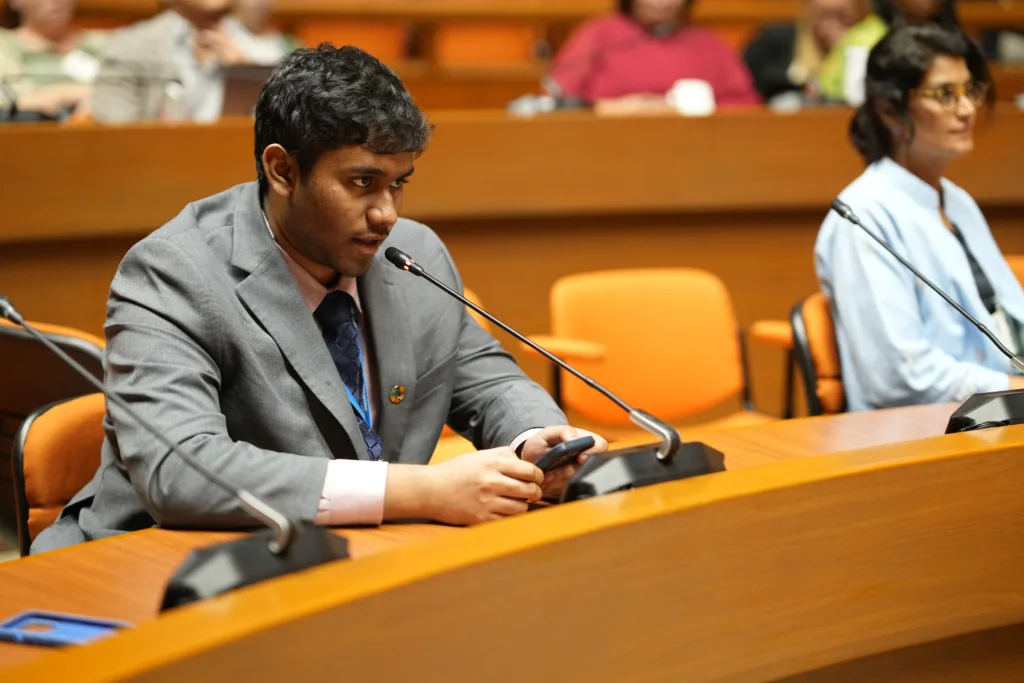
Photo courtesy of United Nations ESCAP
This article originally appeared in the October 2025 issue.