
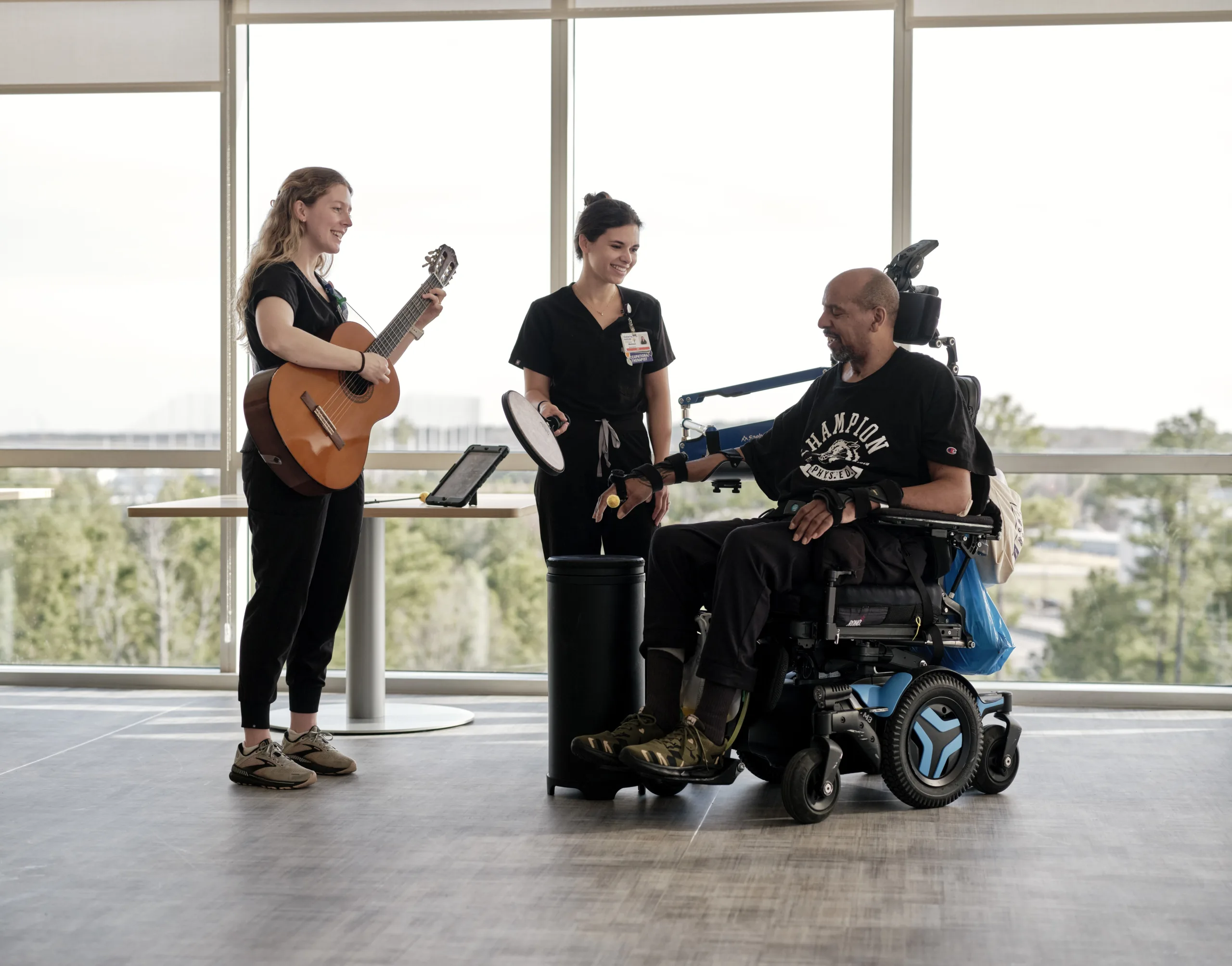
There’s a video that has circulated widely on social media—an Alzheimer’s patient who hasn’t spoken in years suddenly singing along to a beloved song, clear and present, as if the fog had lifted entirely. For most people, it’s a moving mystery. For Audrey Weatherstone, it’s science.
Weatherstone is a board-certified music therapist at Sheltering Arms Institute in Richmond, and what looks like a miracle to the rest of us is, to her, the predictable result of how the human brain stores and retrieves music. “Music is stored in a wide network of neural regions—all throughout the brain,” she explains. “There’s not one music processing center the way there’s a speech and language center, or a motor center. Music is stored everywhere. That’s why music is often our longest-lasting memory.”
That neurological reality is the foundation of her work—and the reason music therapy is proving to be one of rehabilitation medicine’s most powerful and versatile tools.

More Than a Music Lesson
Weatherstone grew up in New York’s Hudson Valley and earned her bachelor’s degree in music therapy at Shenandoah University in Winchester, a rigorous program that combines music theory, ear training, history, and performance with psychology, anatomy, counseling, and clinical practicums. To become board-certified, she then completed a six-month clinical internship—split between a pediatric hospital and adult hospital and hospice care—before passing a national certification exam.
She’s quick to clarify what music therapy is and, just as importantly, what it isn’t. “Music therapy is the clinical use of music to achieve non-musical goals,” she says. “The music is the tool. It’s not about becoming a better singer or a better instrumentalist—it’s about using music to improve your breath support, your memory, your gait speed. Whatever your goal is, the music is adapted to meet those therapeutic goals.”
That distinction separates music therapy from music education. A piano lesson aims to make you a better pianist. A music therapy session on the piano might target fine motor skills, attention, or emotional regulation. The instrument is the same. The purpose is entirely different.
When Words Fail, Music Speaks
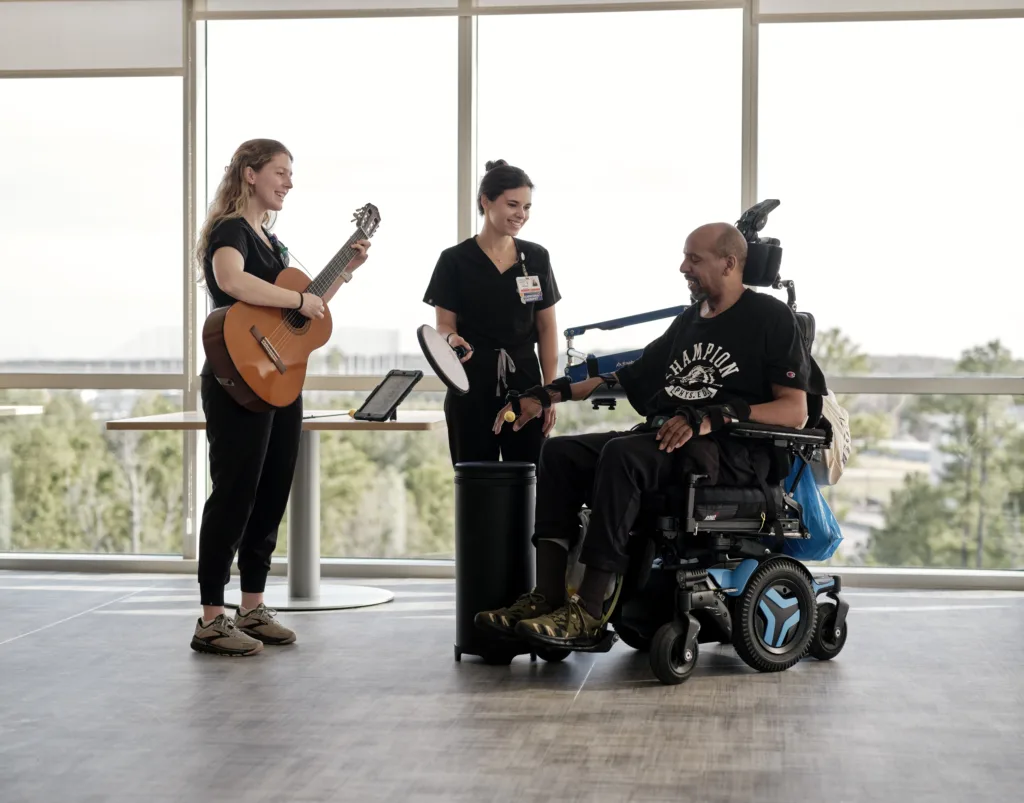
One of the most striking applications of music therapy at Sheltering Arms involves patients with aphasia—the difficulty finding and producing language that commonly follows stroke or brain injury. It’s a cruel condition, leaving people with intact thoughts but damaged access to the words that express them.
Music, remarkably, often finds a way through. “It’s very common for people with aphasia to still be able to sing,” Weatherstone says. “not to be able to say a simple sentence, but to sing a full song. I sometimes see that with several people in the same day.”
It’s not magic—it’s neuroscience. Because music engages such a broad neural network, it can access language pathways through the back door, so to speak, when the direct route is damaged. Weatherstone uses specific singing techniques to strengthen the brain’s speech center, then gradually strips away the musical elements to help bridge the gap between singing and speaking. It’s an approach rooted in neurologic music therapy, a clinical framework built on decades of research into how rhythm, melody, and harmony interact with brain function.
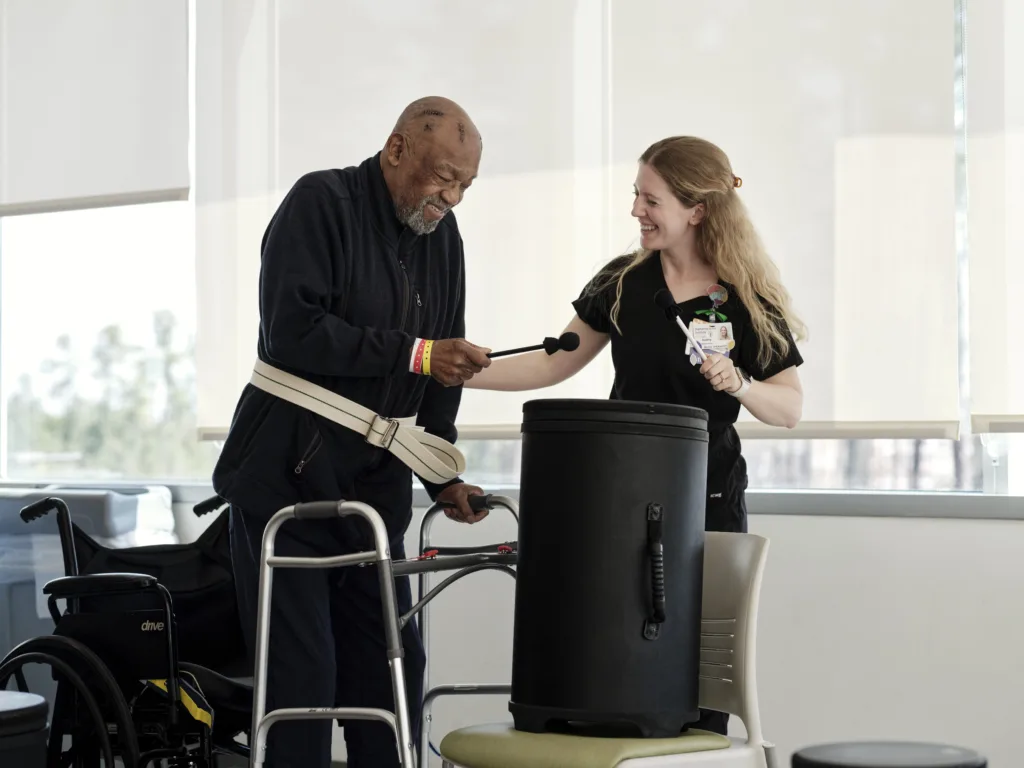
The same principles apply across a range of conditions. Rhythm, for instance, has a direct neurological connection to the motor system—research shows that synchronizing movement to a steady beat can measurably improve gait in patients recovering from stroke or neurological injury. At Sheltering Arms, Weatherstone works across four primary goal areas: cognitive, speech, motor, and social-emotional—domains that align naturally with physical, occupational, and speech therapy.
The Emotional Dimension
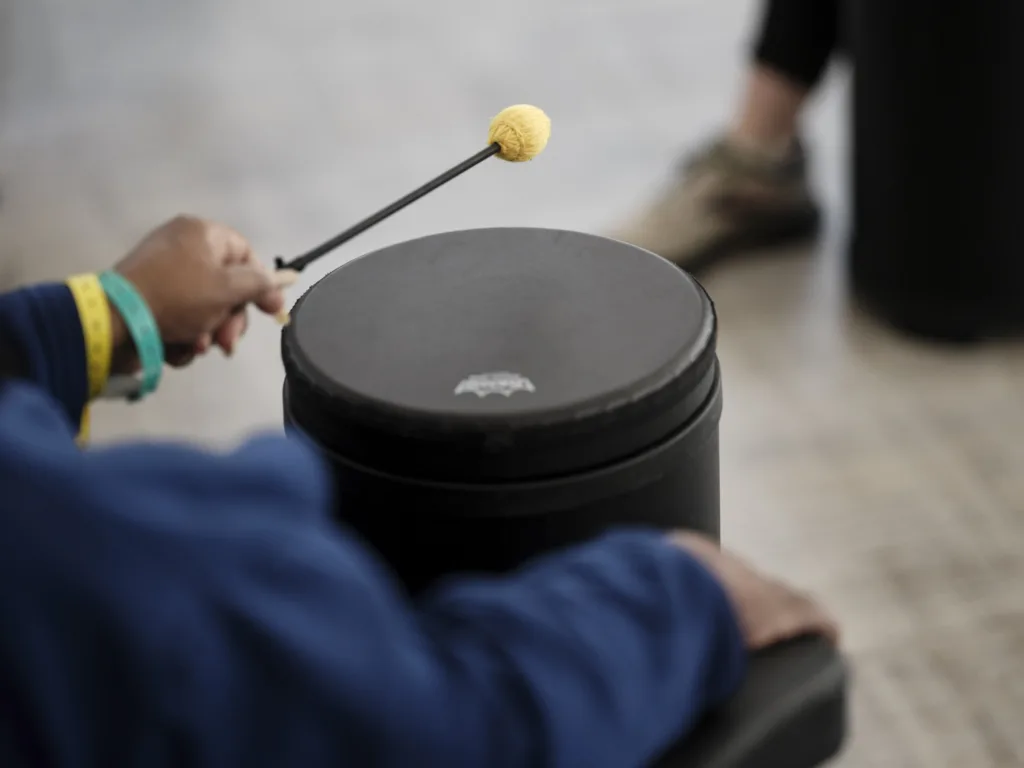
Not every patient at Sheltering Arms has cognitive or speech deficits, and music therapy meets them where they are, too. For patients navigating the emotional weight of a serious injury or illness, music can be a profound vehicle for processing and expressing their emotions.
“Sometimes we write songs,” Weatherstone says. “I love helping patients write songs that express what they’ve gone through or what they hope to achieve. It can be an emotional support coping song. A very different approach but definitely valuable.”
It’s that side of her work—the deeply human side—that she finds most rewarding. “I love to see people express themselves in unique and individual ways,” she says. “I get to see a side of people that other therapists don’t get to see. The way that people will just intuitively sing with me, or start playing a drum, improvising. It’s a unique side of people that I get to see.”
Meeting the Need
Weatherstone joined Sheltering Arms four years ago, when the music therapy program was a modest 10-hour-a-week pilot. She saw the potential immediately—and the unmet need. Through persistent advocacy, she built it into a full-time 32-hour-a-week program.
“I could see people who needed to be seen every day,” she says simply.
In a rehabilitation setting defined by hard science and measurable outcomes, Weatherstone has found something that defies easy quantification: the profound and enduring human need to express, to connect, and to be heard—and music, it turns out, is still the most direct path there. ShelteringArms.com
Music Therapy Resources
The Center for Creative Healing
804-466-3130 | CreativeHealing.Center
830 Southlake Blvd., Suite B, North Chesterfield
A Place to Be
540-687-6740 | APlaceToBeVa.org
4 W. Federal St., Middleburg AND 1600 Village Market Blvd. SE, Suite 108, Leesburg
Anderson Music Therapy
540-384-1677 | AMusicTherapy.com
Roanoke
Tidewater Music Therapy
804-366-4276 | TidewaterMusicTherapy.com
Yorktown
Neuro Sound Music Therapy
571-367-9951 | NeuroSoundMusicTherapy.com
10340 Democracy Ln., Suite 203, Fairfax
There are many more music therapists in private practice around the state, as well as music therapists who work in schools, hospitals, hospices, etc. A great way to find out if there is a music therapist in your area is to contact VMTA (Virginia Music Therapy Association). VirginiaMusicTherapy.org
This article originally appeared in the May 2026 issue.