

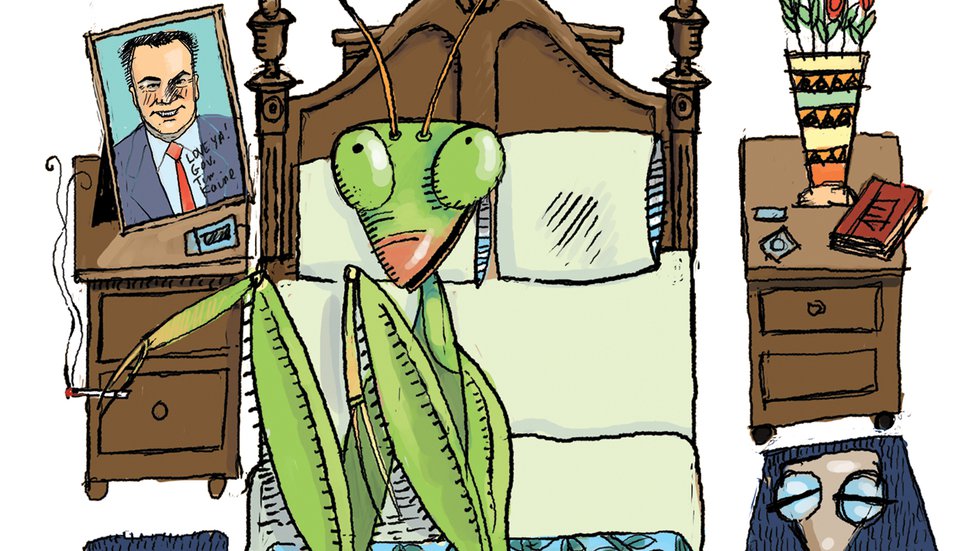
A Carolina bug on the Virginia stage.

In 1976, the Carolina mantis almost became Virginia’s state bug.
A busload of Arlington fifth- and sixth-graders traveled to Richmond in fall 1975 to speak to the Virginia house of delegates on behalf of the state-indigenous Stagmomantis carolina, touting its benefits as a protector of crops by eating the pests that damage plants. “The praying mantis is a noble insect, defending mankind from other predators,” intoned 10-year-old John Meyers, quoted in TIME magazine, in a bit of youthful hyperbole that may have inspired the house’s 50-to-37 vote in favor of the three-inch carnivore. Meanwhile, the senate had chosen the tiger swallowtail. The butterfly’s longer Virginia pedigree finally prevailed, and in 1991 the Commonwealth joined Alabama, Georgia and Ohio in naming it the state insect.
That should have been the last time Virginia’s government and an insect were mentioned in the same breath, but it wasn’t. In March 2006, the nonprofit group Americans for Tax Reform (ATR), led by Republican strategist Grover Norquist, inducted Virginia Governor Tim Kaine into its Mantis Club. In an ATR press release from that time, Norquist explains the qualification for membership: “Like a praying mantis, Kaine first camouflaged himself to voters as a taxpayer-friendly governor, and now that he is elected he wants to eat those same voters who elected him into office.” The Mantis Club is so elite that it seems to have only two other members: former Virginia Governor Mark Warner and New Jersey Governor Jon Corzine.
Whatever anyone thinks of Kaine’s policies, or of Norquist’s interpretation of them, there are plenty of reasons the governor can take the honor as a compliment. And he does. “The governor is flattered by the comparison to such a powerful, results-oriented creature,” says Kaine spokesman Kevin Hall.
Elegant in form, the praying mantis is a powerful—and patient—predator. It waits motionless while a hapless victim bumbles within reach, then strikes hard and fast. Grasping its meal with strong, spiny forelegs, it then munches away with jaws powerful enough to splinter a beetle’s carapace. Also in its arsenal is the ability—unique among all other insects—to swivel its head from side to side, allowing the bug full use of its binocular vision (not to mention a discomfiting air of intelligence). Some of the larger among the 1,800 species in the Mantidae family have been known to attack larger animals—frogs, even small birds—it’s an equal-opportunity carnivore. On the Web, YouTube has a snuff film costarring a mouse.
The bugs aren’t always on the offensive, of course. Among its sophisticated defensive mechanisms is a single “ear” in the center of the thorax, for sensing echolocation vibes sent out by bats—the reason a mantid in flight during the evening sometimes takes a sudden dive.
Yes, they’re famously prone to cannibalism. The female will often—not always—nip off the male’s head or more after (or sometimes before) the reproductive act. Reason: she’s hungry, and her partner’s handy. It takes a lot of energy for her to generate upwards of 400 eggs and the egg case, composed of a foamy material that hardens and protects her young through winter into spring. Not pretty, but it’s nature.
All of this helps explain the praying mantis’s odd grip on our imagination—it’s a perfect example of our tendency to anthropomorphize things that give us the heebie-jeebies, or to turn intriguing beasts into brands. Otherwise, we wouldn’t have the raft of mantis-like Power Rangers villains, the odd Applegate (giant-mantids-disguised-as-human) family in Meet the Applegates, Zorak on Space Ghost, mantid armies in video games, MANTIS software, mantis-named military operations and more. Mantids’ predatory skills even inspired the Praying Mantis style of kung fu 350-some years ago, when a monk watched the carnivore kill a cicada and integrated what he learned into his own practice.
So, which is correct, ‘praying’ or ‘preying’? Yes. While most answers to this question lean toward the more oft-used religious reference, the fact is that both are informal, unlike the always consistent Linnaean Latin, so it really doesn’t matter. Does the insect prey? Most distinctly. Does it actually pray? Of course not. (Well, maybe the males do.)
The ATR folks may enjoy knowing that mantids are the closest relatives of the cockroach. Then again, some maintain that cockroaches may one day rule the world. We’ll see.