


Picture a nondescript, water-filled depression somewhere in the outdoors: a roadside ditch, the flooded low-lying sections of a fallow agricultural field, a boggy spot which will evaporate into dried mud within a few short weeks. As insignificant as they might seem, in spring and summer these fleeting and fast-drying pools can play host to a brief, fervid burst of life. And one species you will find taking advantage of them is the Eastern spadefoot.
Eastern spadefoot are amphibians, sometimes referred to as toads, and somewhat resembling toads, that are not, in fact, toads. Rather, they are frogs (a “primitive frog,” a Connecticut state wildlife website says, which sounds a tad judgey) that belong to their own family, the spadefoots, or Scaphiopodidae if you like your wildlife in Latin.
According to Jason Gibson, assistant professor of biology at Averett University, a spadefoot’s body is covered with “tubercules,” which provide defensive and offensive advantages. Some are sensory organs that allow the frog to detect movement of both predators and prey. Others are poison glands, which make a mouthful of amphibian less of an appealing snack. “You can’t touch this frog without getting poison on you,” says Gibson, adding as a cautionary note, “I have had a person handle one before and stick their finger in their eye.” Unpleasantness ensued.
For most of its life, the Eastern spadefoot leads a reclusive existence. Spadefoots (spadefeet?) are “fossorial” says Gibson, which means they spend much of their time underground. They get their name by way of the specific small, hard tubercule—the “spade”—on each of the rear feet, which they use to dig themselves a home. “They use that little tubercule like a shovel and can literally burrow into soft sediments,” explains Gibson. They work their way backwards into the earth, and, thus dug in, are able to hide from predators, keep their skin moist even in hot or dry weather, and, in winter, retreat below the frost line to keep from freezing.
Even when they do emerge, however, it’s not exactly Spadefoot’s Big Adventure: they are nighttime ambush predators that stick close to home. Under the cover of darkness, “They hang out near their burrow and pick off insects that walk near,” says Gibson. And so, despite not being uncommon in the Commonwealth, Eastern spadefoots “are hard to find and hard to see,” says Gibson.
Until suddenly they aren’t. Because on some warm rainy night in the late spring or early summer, all the local spadefoots all at once will decide it’s time to breed, and set out on a grand journey that might have them hopping as much as a quarter-mile or more (no inconsiderable distance given that even a large adult measures only about 2.5 inches) to one of those temporary puddles of a pool mentioned above—often the same pool in which they themselves were hatched.
“When they come out breeding, it is an amazing event,” says Gibson. “You have frogs everywhere.”
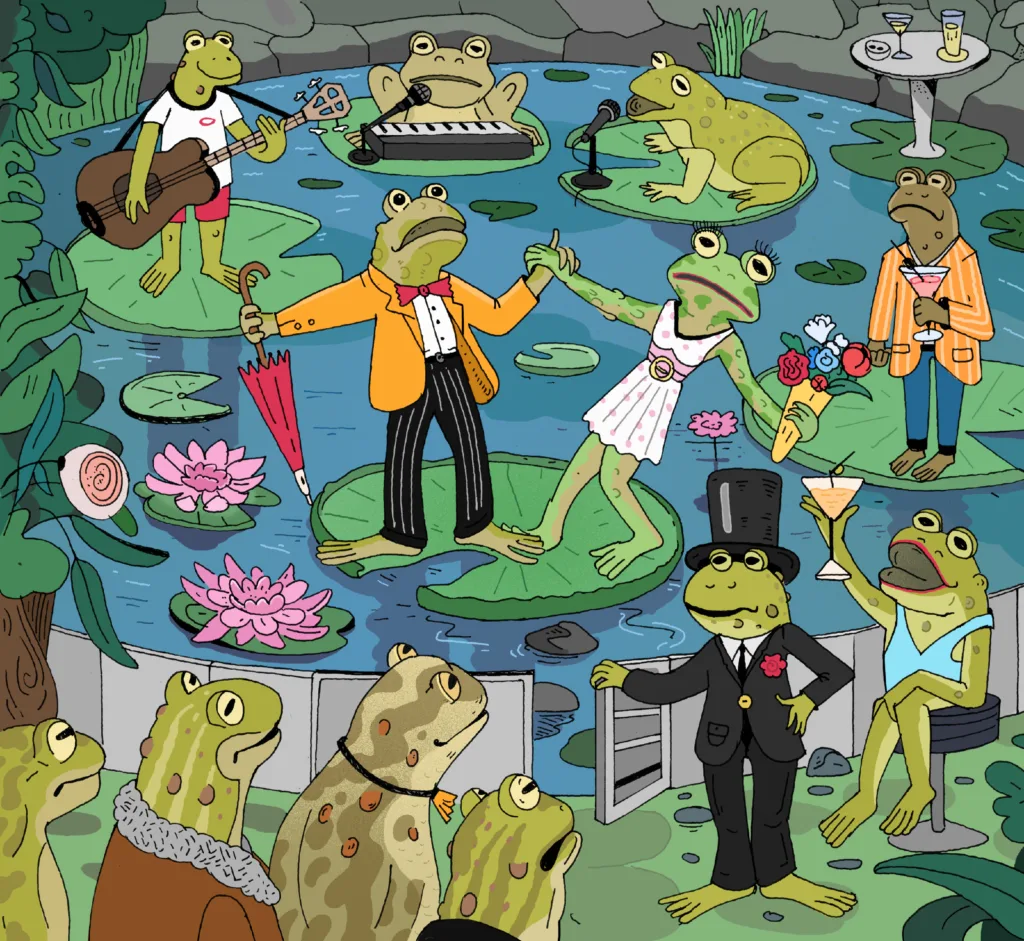
How exactly do all the spadefoots decide together that tonight’s the night for love? That remains an unanswered question, says Gibson. “They will explode out one night or a couple of nights and then they are gone.”
In the breeding pool, the females lay thousands upon thousands of eggs, then all the spadefoots hotfoot it back to their own nondescript hole-in-the-ground burrows they left earlier—an impressive bit of reverse way-finding. Meanwhile back in the breeding pool, it’s a race against time and evaporation. “These pools are typically not very deep,” says Gibson, and “they dry up pretty fast.”
To beat the desiccation clock, therefore, the eggs must hatch quickly into embryos which zip through their development in a rush in order to exit as tiny juvenile spadefootlets (“not even a quarter of a size of a dime,” Gibson notes) before the pool goes kaput. Sometimes, it doesn’t work out so well. “The breeding pool can dry up so fast that thousands of them die,” says Gibson. “They are a boom or bust species.”
If you aren’t likely to see a spadefoot, you can instead try your luck and listen for them on a warm, rainy night. But fair warning: their call, while no doubt music to the ear of fellow spadefoots, sounds less love song and more like the crankiest guy in line at the DMV. Forget the bullfrog’s swoon-worthy baritone, the spring peeper’s cheerful little pips, or the tree frog’s delighted post-storm serenade. No, spadefoots deliver a disgruntled chorus of bleats, as though in collective ill-tempered agreement that they just don’t make puddles like they used to.
Still, imagine the moment: You’re out on a muggy night, rain pattering down, when that distinctive grousing drifts across the darkness. Like glimpsing a bobcat or witnessing a sturgeon breaching, catching the grating mating call of a spadefoot could be another dab on your bingo card of elusive Virginia wildlife. So go have a listen when the conditions are right, and see what you can hear.
Are you wondering what crooning spadefood toads sound like? Visit VirginiaHerpetologicalSociety.com or press play on the organization’s audio here:
This article originally appeared in the April 2026 issue.