
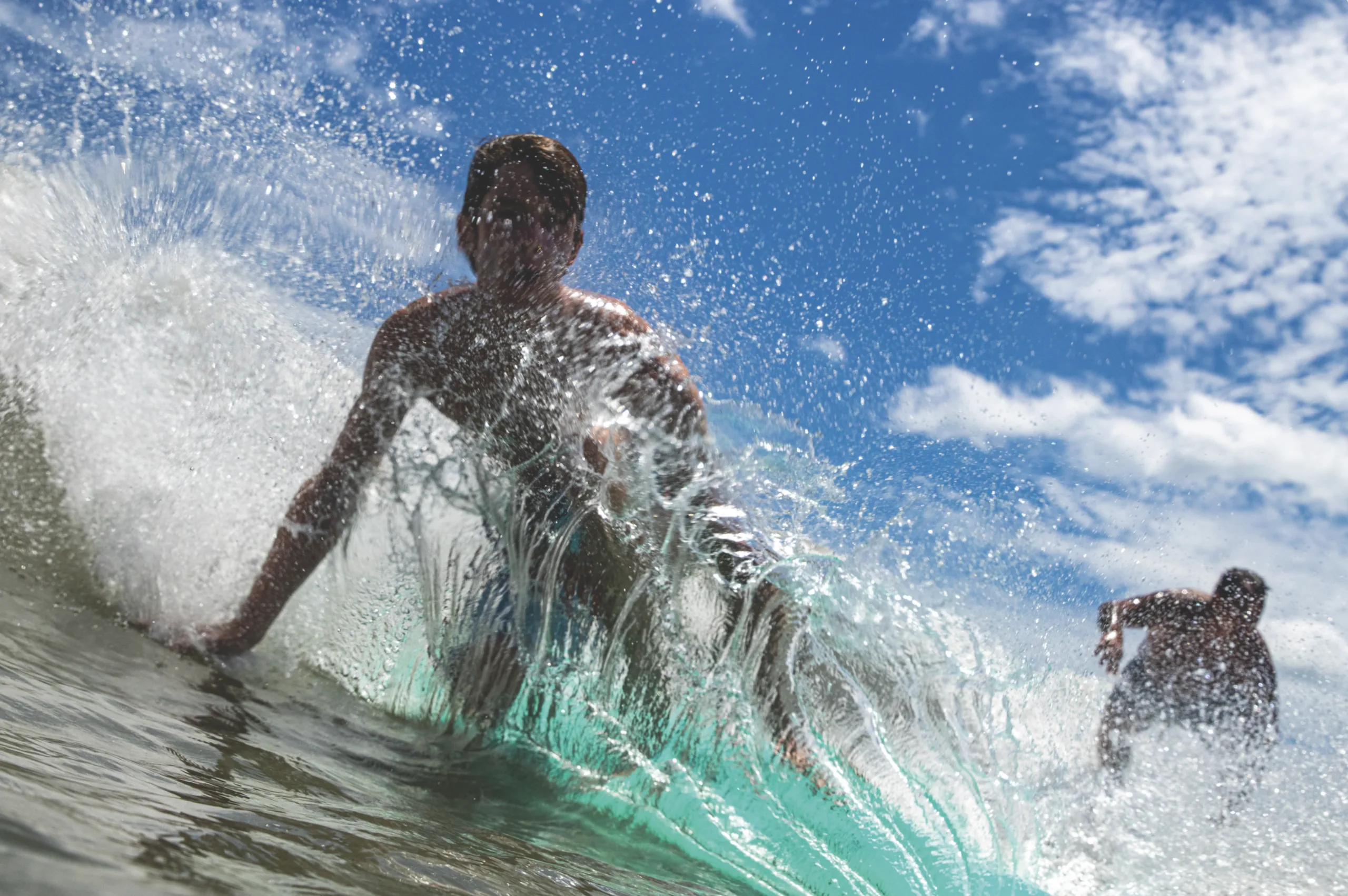
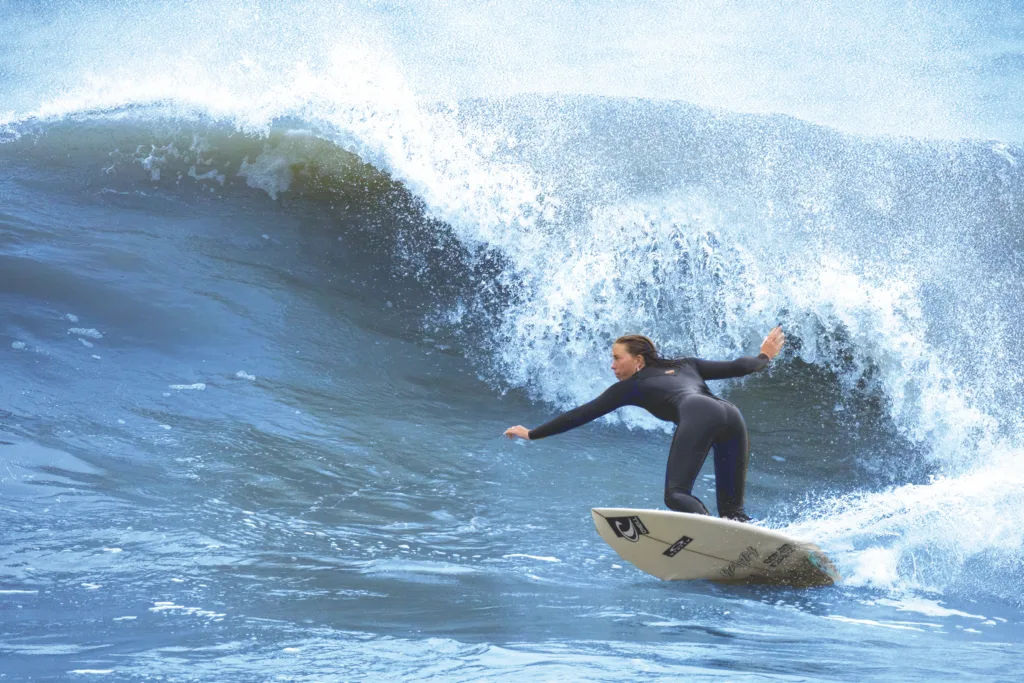
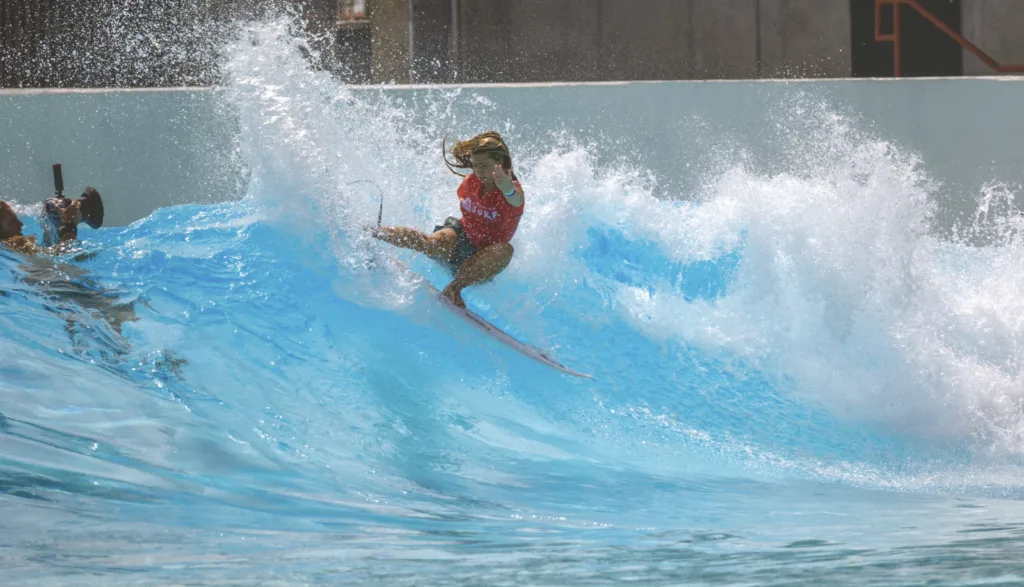
Pro-surfer Rachel Wilson paddles hard with the surging tide, noses her board into a 6-foot aquamarine crest, and springs to her feet. Like a dancer, she drops into the wave, carving fluid s-shapes that slash through the pocket and propel her up and down the barrel ahead of the break. Art and athleticism merge for a timeless half-minute, and it’s easy to forget that I’m standing outside in the dead of winter and this magic is unfolding in a man-made facility.
Wilson wears a full-body, jet-black wetsuit with neoprene booties and gloves. She’s wrapping up a one-hour practice session with an all-star cast of friends at Virginia Beach’s new Atlantic Park Surf, where she works as an instructor and elite-level coach. Wilson watches her performance from dual angles on a big screen as Jason Borte, the director of coaching and East Coast Surfing Hall of Famer, applauds and offers tips for improvement. She then takes a break from the action to warm up in an 89-degree wading pool before leading a small group lesson for talented junior up-and-comers with pro ambitions. The 2.67-acre lagoon opened last August, operates year-round, and is the first of its kind in the U.S. It boasts sandy beaches and AstroTurf lounge areas, local food trucks, retail space, a rental center, onsite restaurants, and two giant, wedge-shaped pools that can produce upward of 1,000 perfect waves per hour.
The group shouts praise, and fist bumps fly as Virginia Beach native and recently crowned men’s East Coast Surfing Championships (ECSC) bronze medalist, Coby Nguyen, paddles into a swell. “To me, this scene exemplifies what Virginia Beach surfing is all about,” Borte tells me. He spent eight years advocating for the park’s creation—and flew to Disney’s iconic Typhoon Lagoon in 2018 with a then-14-year-old Wilson to film pitch videos. The multigenerational community is tight-knit and supportive, yet also fiercely competitive. “Surfers here are a scrappy breed and have been pushing one another to the next level for as long as I’ve been alive,” Borte continues. “To me, this park is a testimony to that spirit and the immense distance that we as a community and this sport have come.”
Humble Beginnings
In the early days of the Virginia Beach surf scene, the idea of a 10-acre luxury development centered around a state-of-the-art wave lagoon and 5,000-person music venue in the heart of the resort community seemed less sci-fi than preposterous. As West Coast surfers were chasing big breaks at Sunset Beach or Nazaré’s 80-foot waves off the coast of Portugal, Virginia Beach and its 5-foot breaks would not have been regarded as worthy of such grandeur.
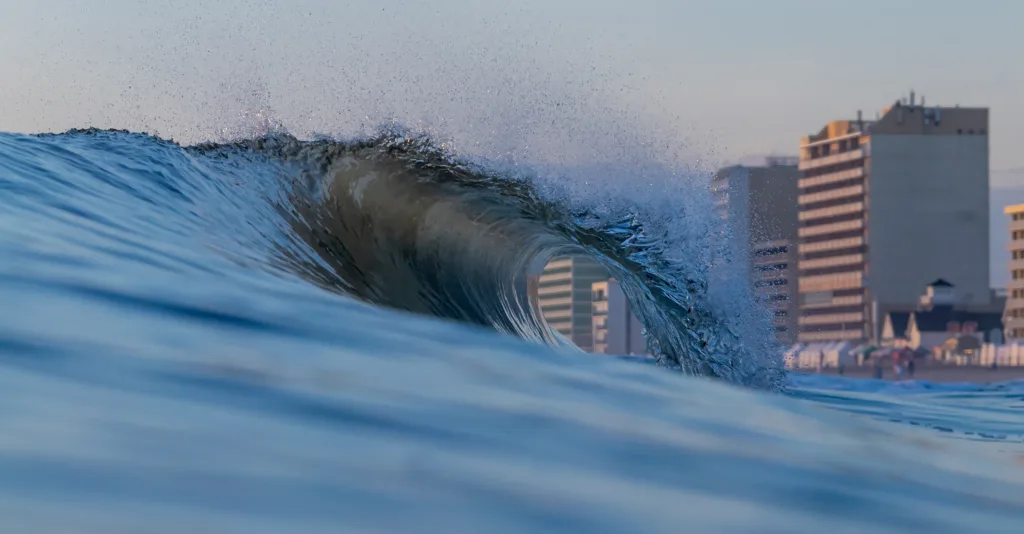
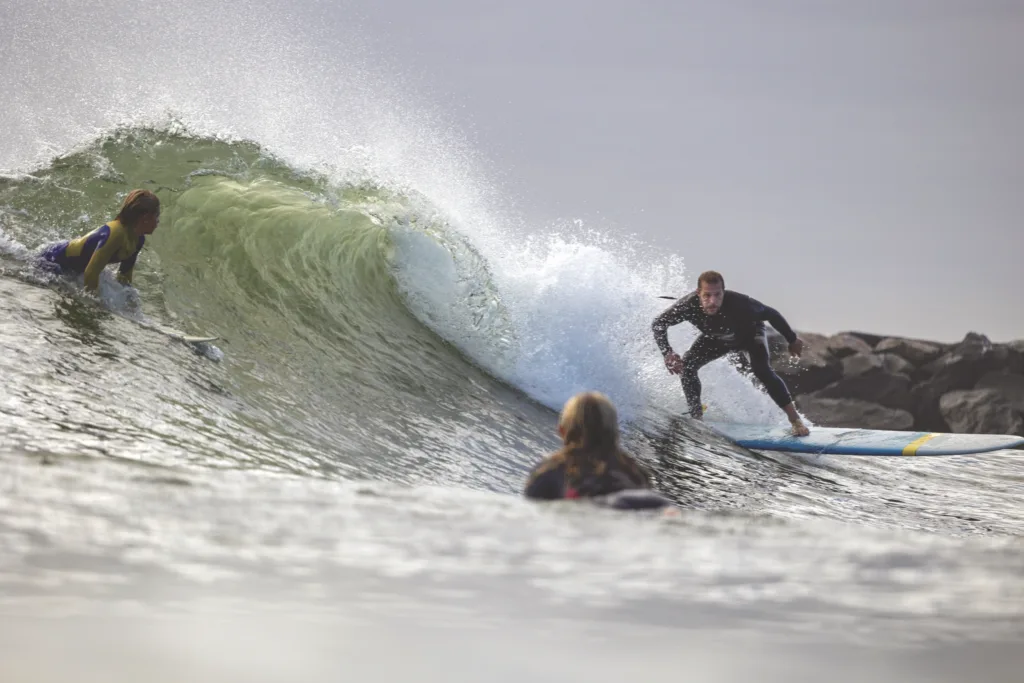
“My brother was nine years older than me and had to buy his first board at a Western Auto hardware store,” says former World Surf Tour star, Wes Laine, whose family relocated from North Carolina to Virginia Beach in 1970. Back then, mainstream East Coasters didn’t consider surfing to be a real sport, and there were just three dedicated shops in the entire state of Virginia. “Most people thought of us as hippies or bums and viewed surfing in a negative light,” says Laine.
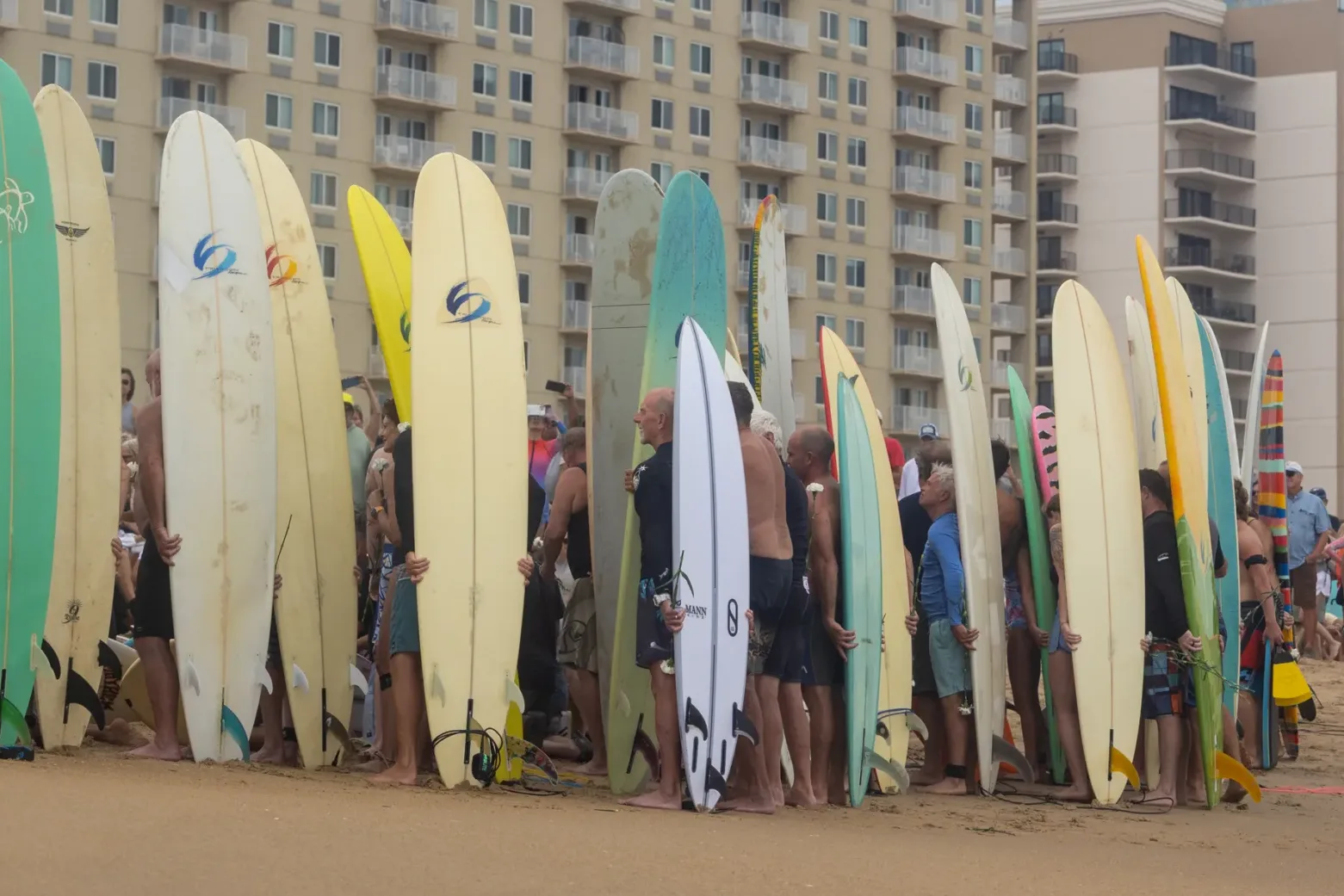
But a cadre of local enthusiasts was fueling a cultural revolution. Pete Smith and Bob Holland had launched an eponymous 19th Street retail store back in 1963 that imported cutting-edge gear like Hobie Surfboards and O’Neill bodysuits from California. Bob White opened neighboring Wave Riding Vehicles in 1967, where he and a small team pioneered their own line of handcrafted planks. The now-famous 17th Street Surf Shop helped the scene take off when it cut the red ribbon in 1970.
The proprietors gathered with a small but intensely dedicated group of patrons, fellow aficionados, and curious greenhorns by First Street’s Virginia Beach Fishing Pier to catch waves. They successfully lobbied to relocate the newly formed annual ECSCs to their home base in 1963. Next came the Eastern Surfing Association (ESA), which sought to boost youth participation and create a competitive funnel for would-be pros. Events drew riders from Maine to Florida and gave locals a chance to witness avant-garde shredders in action.
Gathering Momentum
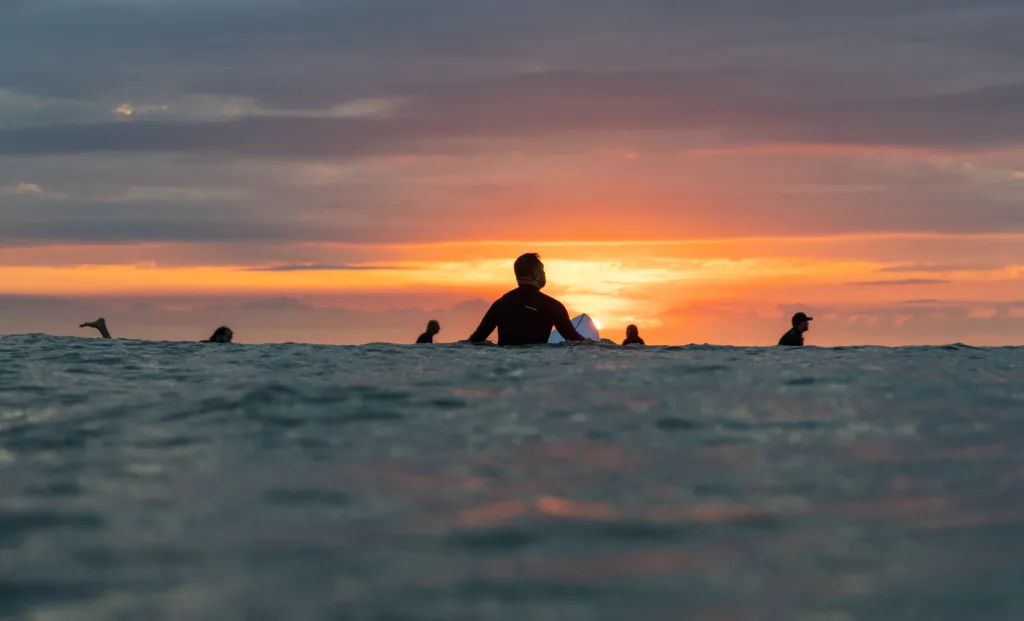
“Those guys helped change public perception and laid the foundation for all that we have today,” Laine says. He remembers afternoons tagging along with his brother’s crew to catch swells by the pier or swapping school for early morning van rides to Hatteras Island to chase post-storm swells. Riders discussed exploits at the local shops, which “felt more like clubhouses or social gathering places than commercial enterprises.” Laine gawked through the pages of Surfing Magazine and soaked up tales of mythic-sounding Shangri-las like Hawaii’s Banzai Pipeline or South Africa’s Jeffreys Bay.
“I dreamed of being good enough to surf in those places and worked my ass off to make that a reality,” says Laine. Having to wait on good waves and brave frigid winter waters to practice brought the unexpected advantage “of being able to handle a broad variety of conditions and deeply appreciate waves, even when they weren’t ideal.”
Laine developed a smooth, technically polished style that helped him win numerous boys and juniors division championships, then claimed a spot on the World Surf League tour in 1982. A near-decade of global victories, top-10 performances, and appearances in landmark films like 1984’s The Performers made Laine a superstar and won Virginia Beach a reputation as a breeding ground for formidable surfers.
“He was a living legend,” says Borte. “We’d spot Wes in the water when he came off tour and drop everything to paddle out there and try to figure out what he was doing.”
The Next Wave
The obsession was part starstruck awe, part pragmatic. “There were no surf camps or even private lessons at that point,” Borte says. What’s more, there was a pecking order where the best surfers got first dibs on quality waves, “and they didn’t just hand out their secrets; you had to win their respect to be acknowledged.”
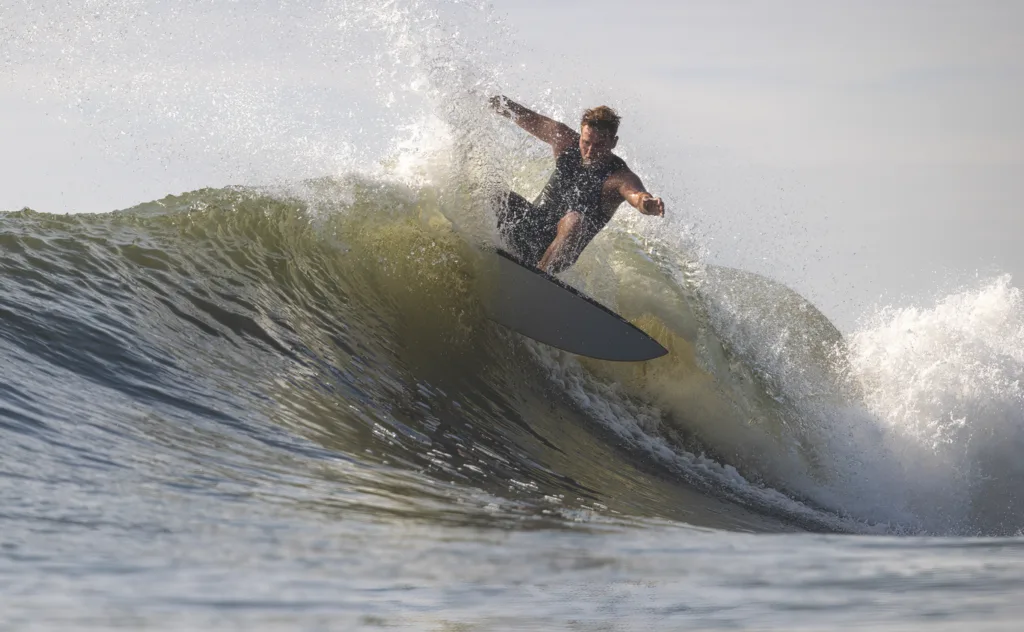
Aspiring journeymen thus relied on observation and trial and error to improve. Borte mastered the self-reliant art of surfing and went on to become an ESA all-star and World Surf League East Coast champion in the 1990s. Time on tour and a knack for writing brought further accolades through bylines in major outlets, like Surfing Magazine, and a co-writing job on megastar Kelly Slater’s 2003 autobiography, Pipe Dreams: A Surfer’s Journey.
A New Era
As their competitive careers waned, Borte and Laine transitioned to teaching. They partnered with major sponsors like Billabong, Wave Riding Vehicles, and Quicksilver to create groundbreaking namesake surf schools in 1997 and 2006, respectively.
“The alt sports boom of the ’80s and ’90s pushed surfing into the mainstream,” says Borte. But the city needed to parlay interest into greater participation—particularly among girls and young women. The learning centers did exactly that. They attracted hundreds of annual participants, helped spawn new competitions, camps and schools, and boosted retail sales and tourism visits. Sponsorship opportunities for athletes and municipal support for events surged. Surfing’s active yet laidback and nature-based ethos became embedded in the Virginia Beach brand.
“It’s become an integral part of our identity and a major economic driver,” says Deputy City Manager of Virginia Beach Amanda Jarratt. There are now more than 15 surf shops in the city alone—including five Coastal Edge locations managed by Laine. Ask repeat visitors to think of images “that define Virginia Beach,” Jarratt says, “and their list will probably include a surfboard.”
The Future Paddles Out
By the time Rachel Wilson paddled into her first wave at age 8, the youth scene was radically different from the one experienced by Laine and Borte. “Pretty much everyone I grew up with had at least tried surfing,” says Wilson. Most families owned a board, and older adherents “were super supportive of anyone who was seriously trying to learn and get better.”
Feedback from peers and local fixtures was abundant and freely offered. Lessons with veteran riders like Borte and a robust local schedule of competitive events further hypercharged development. Wilson capitalized and was already a top-25 nationally ranked junior when she shocked the region and qualified for the women’s pro circuit at age 17.
“The rate of advancement compared to when Jason and I were coming along is just insane,” says Laine.
The Machine That Makes Waves
The $350 million addition of Atlantic Park Surf has further upped the ante. “These kids can get in there whenever they want and practice the same move for an hour at a time on perfect waves, then review every ride from multiple angles,” Laine continues. The next generation of riders “is going to be unreal.”
Wilson and Borte point to up-and-comers like 14-year-old Pungo native and USA Surfing Junior National Team member, Story Martinez, as proof.
“I look back at where we started and where we are now, and it’s like night and day,” says Borte, who reflects on the immensity of transformation in his new book, Virginia is for Surfers. “Yet, in some ways, nothing has changed at all,” he continues.
The thrill of riding a wave, let alone one that’s traveled thousands of miles across the vast Atlantic Ocean to crash on the sandy, sun-kissed beaches of Virginia, remains as timeless and intoxicating as ever.
This article originally appeared in the August 2026 issue.