
The plate in front of me has followed a path of 6,183 miles and many millennia before it got here. The first versions of the dish—simple roasted eggplant with garlic, turmeric, and poached eggs—were created thousands of years ago near the Caspian Sea, in what’s now northern Iran. It became a staple across the Persian empire, with many regional and personalized variations.
Ultimately, the dish, mirza ghasemi, found its way onto page 92 of Cooking in Iran, the masterwork of regional Iranian cookery by Najmieh Batmanglij, the grande dame of Persian cuisine, who is credited with single-handedly introducing American cooks to the food of her native land. She spent three years traveling around the country finding authentic local versions of recipes, including this one.
And tonight she happens to be sitting across from me at Joon, the Iranian restaurant in Tysons Corner, where she is executive chef, tucking into the eatery’s version of the dish. She wears her crisp chef whites. Her gray hair is neatly arranged, with a perfect curl at the top of her forehead like a small parenthesis. Her eyes are full of smiles.
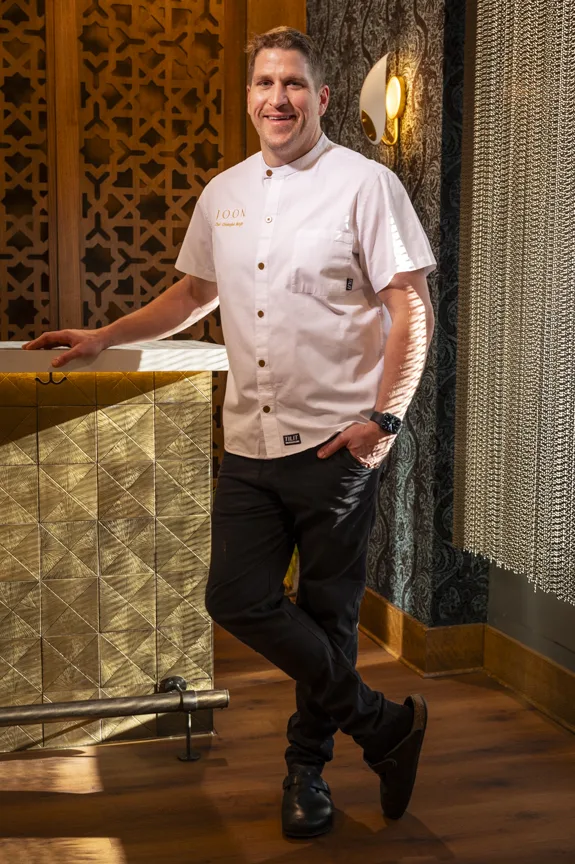
But the version of mirza ghasemi we’re eating isn’t the exact one you find on page 92. It’s an updated iteration, localized and reimagined by Christopher Morgan, chef-owner of Joon, who collaborates with Batmanglij to create modern interpretations of the traditional recipes.
Morgan presents the dish as a whole, split-roasted eggplant sprawled across the plate, draped with a wildly fragrant filling of its own soft flesh, plus tomato, garlic, and turmeric with touches of honey and pepper. His recipe uses two kinds of roasted cherry tomatoes from nearby Moon Valley Farm, tomato paste for “an umami blast,” and a touch of heat, unheard of in northern Iranian cooking, to add “just a bit of je ne sais quoi,” he later explains in the kitchen. A cured egg yolk is poised like a saffron jewel on top; a fist-sized frill of mint, parsley, and locally grown Iranian basil sprouts at the rim.
The whole thing—respectful of the traditions Batmanglij brings forward, enlivened by Morgan’s contemporary vision—is a knockout.
“Very good,” Batmanglij says, nodding as she sweeps in a mouthful, mixed with her signature tahdig rice.
The unexpected collaboration at Joon between the West’s unrivaled expert in Persian cooking and a chef who’s earned a Michelin star (Maydan in Washington, D.C., 2019) has not gone unnoticed. It opened in 2023; in 2024, The New York Times named it among the “50 Places We’re Most Excited About Right Now.” Batmanglij and Morgan were named semi-finalists for the James Beard Foundation’s “Best Chef: Mid-Atlantic” award that same year.
The chefs met in 2013, when Batmanglij was teaching Iranian cooking to small groups in her Georgetown kitchen. A McLean native, Morgan had just returned home from various cooking jobs in San Francisco (“I’m a huge mama’s boy,” he says with a slightly embarrassed grin). The Washington-area restaurant scene was heating up, and he was looking for his next move.
Things got a bit hairy in the kitchen that night, and Morgan stepped forward to give Batmanglij a hand.
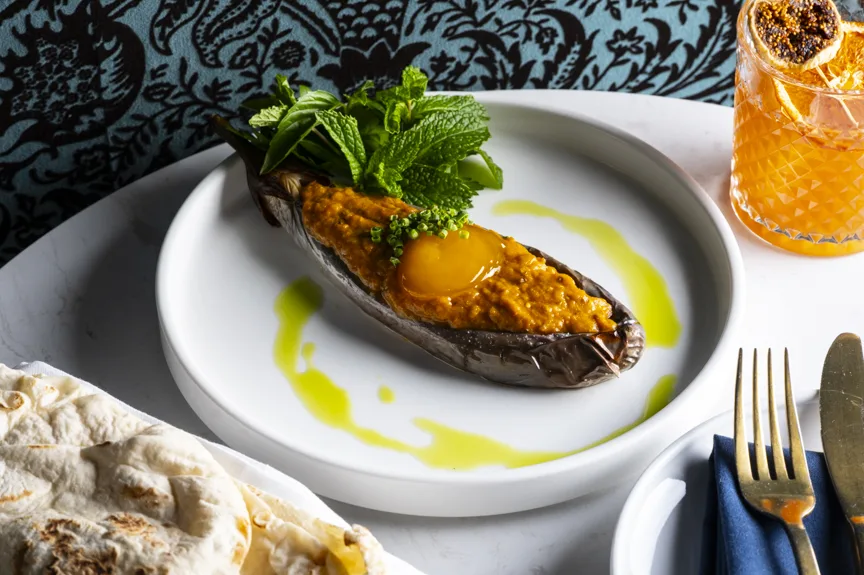
topped with a saffron-cured egg yolk, mint, and basil.

“I had no idea who he was or his background,” she tells me. “But then, suddenly, he is cooking. Here is this young, beautiful man—and he can actually cook!” The “young, beautiful man”—Morgan is 37, with auburn hair and a camo baseball cap worn backwards to lead the kitchen tonight—is embarrassed for a second time.
And so in Batmanglij’s kitchen, a relationship was born, and he became a kind of assistant and understudy. Their affection is obvious. They address each other with a playful formality: Morgan refers to her as “Chef Najmieh” in our conversation; she jokingly calls him “Christian,” while he is “Chris” to all others.
Their rapport is easy. When I joined them, an hour before a Friday dinner service, they were discussing the possibility of creating a dish to serve 500 for a celebration of the Persian New Year at New York’s Metropolitan Museum of Art, something they’ve done for two years. They didn’t seem to be sweating it.
I asked how the collaboration at Joon worked.
“I’ll call her and say, ‘OK, Chef, this is in season now, what dishes can I reference that will use this right?’” Morgan says. When we spoke, they were talking about what they might do with sour cherries and chicken.“
That starts a conversation; maybe she’ll come in next Wednesday.”
“Or maybe we’ll cook together in my kitchen,” she says. “I’ll tell him what I think, what I know from the recipes,” Batmanglij says.
But what if she doesn’t like his cheffy, farm-to-table, sometimes idiosyncratic interpretations?
“I’ll try something else,” he says. Together, they’ll taste things. “It usually works out.” Batmanglij says it’s her responsibility to ensure the final dish, no matter how evolved, respects the Persian culinary traditions.
On the night of our visit, Batmanglij hadn’t yet tried the final version of their most recent collaboration, so a dish was brought for us to share.
It was half a chicken, an adaptation of peach khoresh, whose recipe is documented in Food of Life, her breakthrough book that first brought Iranian food into American kitchens. Morgan drew on the basic flavors and, in a characteristic multi-culti tweak, added a French-style mustard jus soured with liquid from torshi—Persian pickled vegetables—to balance the sweetness of the luscious grilled peach sitting alongside. Rings of pickled apricots and Jimmy Nordello peppers—mild-flavored, beautifully blistered spears of crimson—complete the plate. Batmanglij tastes and again nods in approval.
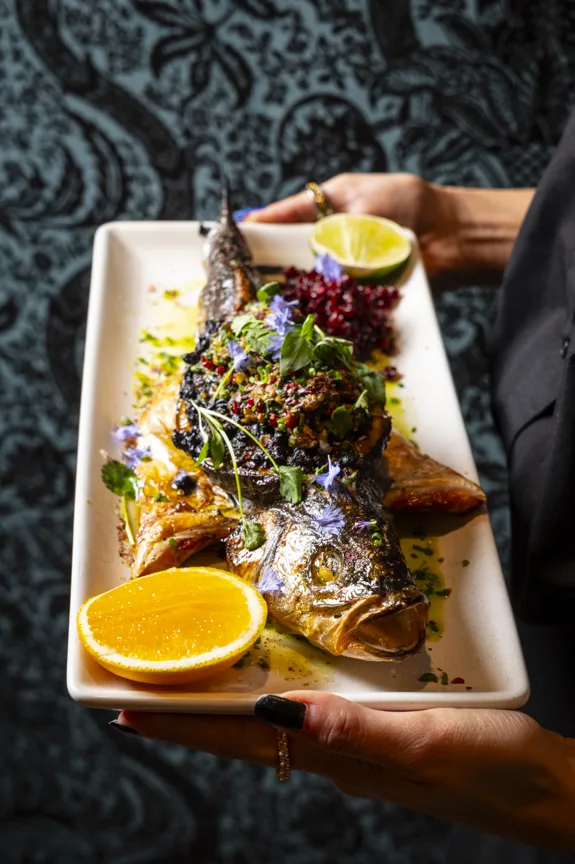
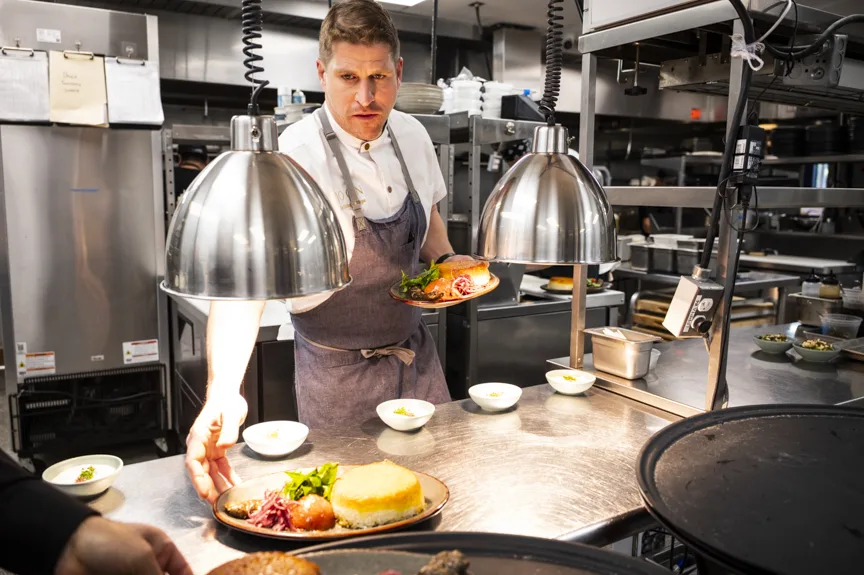
The plating at Joon is gorgeous, each dish leaving the bright and busy kitchen with vigorous color: a garland of fresh herbs, a dusting of pistachio, a crown of pomegranate seeds, a scattering of minced chives.
All the kitchen work transpires in an atmosphere of playful banter. Maybe it’s Morgan’s backwards ballcap, maybe it’s Batmanglij’s warm, matriarchal presence, or maybe it’s the fact that, knowing they’re a success two and a half years in, the team can relax a bit. Whatever the reason, on the Friday night I visited, Joon’s kitchen seemed one of the happiest I’ve visited.
The vibe carries into the sleekly modern dining room, where the hospitality is Persian, which is to say convivial and communal. Servers encourage customers, even if just a twosome, to order several small dishes.
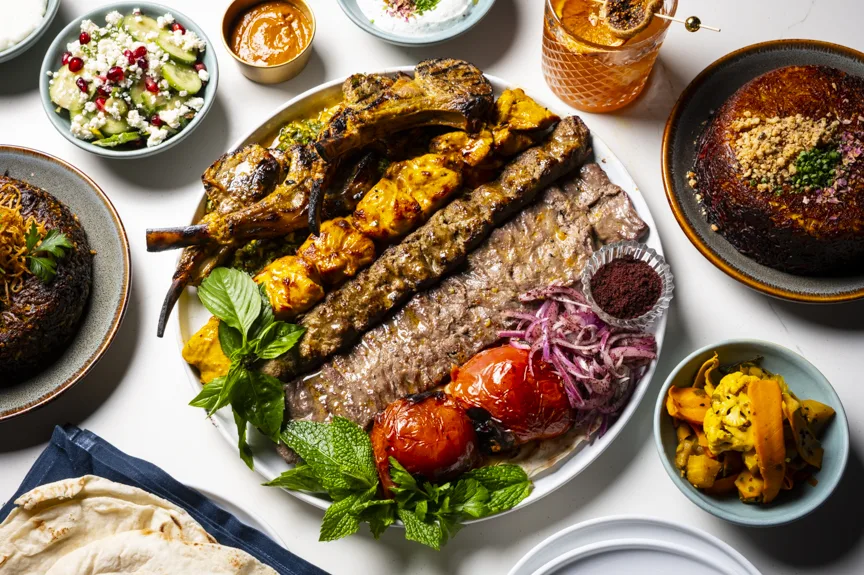
The menu is full of standouts, including what might be the best (and best-looking) hummus, falafel, and kebabs you’ll be served anywhere. The whole branzino, stuffed with pistachio, herbs, barberry, and sour orange, arrives at the table like a triumph, delivering a cascade of sweet, sour, and rich flavors tumbling together.
The restaurant’s signature dish, of which Batmanglij is quite proud, is its single serving of tahdig—rice cooked crisp at the bottom with butter, garlic, and saffron, and inverted for presentation at the table. You’ll want to nibble the fragrant, caramelized crust all night.
But as Batmanglij explains, Persian meals aren’t just about the food—at Joon or anywhere they’re served. “It’s about sharing, the conversation, telling stories, sharing the culture,” she says. It’s a task she’s devoted her life to. Chef Najmieh and Christian work at it every day.

garnished with saffron ice, fresh mint, and basil.

honeycomb, and candied walnuts is served in a coupe glass.
This article originally appeared in the February 2026 issue.